The Lit Review
1 2017-12-12T17:25:47+00:00 LMU 7c67764c12c98f44dde9b0c909430ac1f143977f 1 7 by Willow Wittliff plain 2018-09-11T23:18:14+00:00 LMU 7c67764c12c98f44dde9b0c909430ac1f143977fThis page is referenced by:
-
1
2018-03-12T00:33:56+00:00
APA (aka American Psychological Association's style manual)
27
plain
2018-09-26T22:06:26+00:00
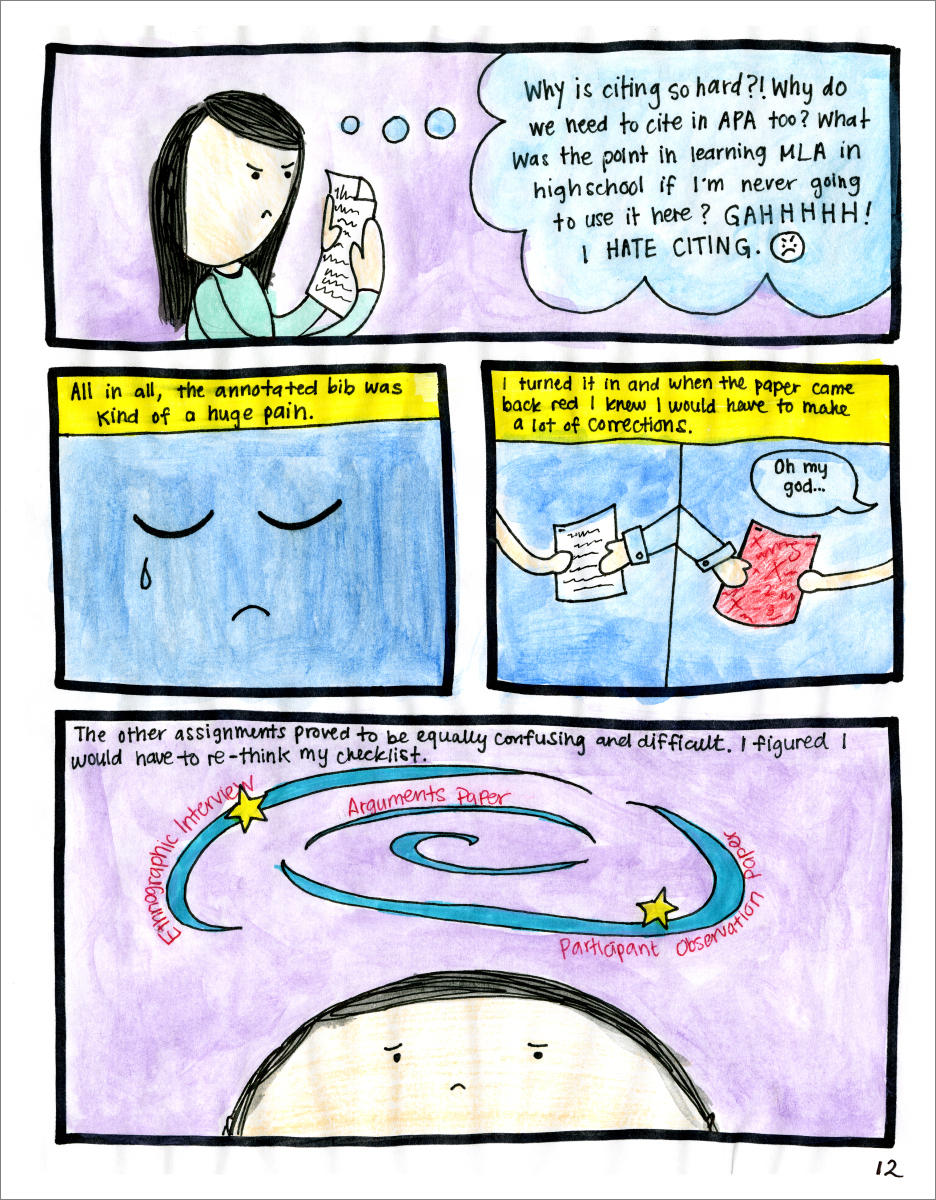
Not only must students try to understand the dense and impenetrable writing in academic journals. Students must learn to rewrite academic discourse and to cite it correctly, using the American Psychological Association Style Manual (aka APA). Even if students type fast and well, APA will slow them down to a crawl, requiring them to refer to journal articles to get information (authors, title of article, year published, journal in which the article is published, volume and issue of that journal, page numbers). And then students need to follow the form. What is capitalized and what is not? What is italicized? How many spaces are needed between the various parts of the citation? And that’s just for the list of “References” at the end of the student’s literature review.
Even more difficult is how to cite sources within the body of the paper. “Should I cite the source at the beginning or the end of the sentence?” “Can I cite a source in the middle of a sentence?” “How do I cite more than one source within parentheses?” “Is the date needed each time the author is cited?” “How do I cite a source cited within another source?” Students have hundreds of questions. Moreover, the student may have anger or “hate” about having to use APA, particularly if they have already mastered a different form of citation (e.g., “MLA”).
In Claire Dobyn’s comic, she admits to herself that the “APA citations are kicking my ass.” In this sense, APA is the enemy that is symbolically scapegoating and dominating Claire because Claire lacks knowledge about how to use APA. And Claire’s acknowledgment that the “lit review is shitting on [her]” is mortifying, and Claire uses this mortification to motivate herself. The shadow presence of fear and Claire’s lack on control over the situation mark her representation of shame. She points to her mirror image and tells herself that “those instructions should be afraid of you!”
Claire is confronting a version of herself in the mirror where she lives. Mirrors are prominent in autobiographical comics, and “can form a potent visual metaphor for the ambiguity involved in seeing something that is and is not ‘me’” (El Refaie, 2012, p. 66). As the narrator, Claire is sharing a version of herself with her character, and the reader. In using the mirror, Claire is communicating with herself, showing herself, “which entails revealing and uncovering the shameful contents, recognizing and accepting one’s shame, dragging it out to the conscious surface, and sublimating or transforming it into humor” (Bassil-Morozow, p. 46). The shadow is lessened when confronted and acknowledged by Claire’s trickster.
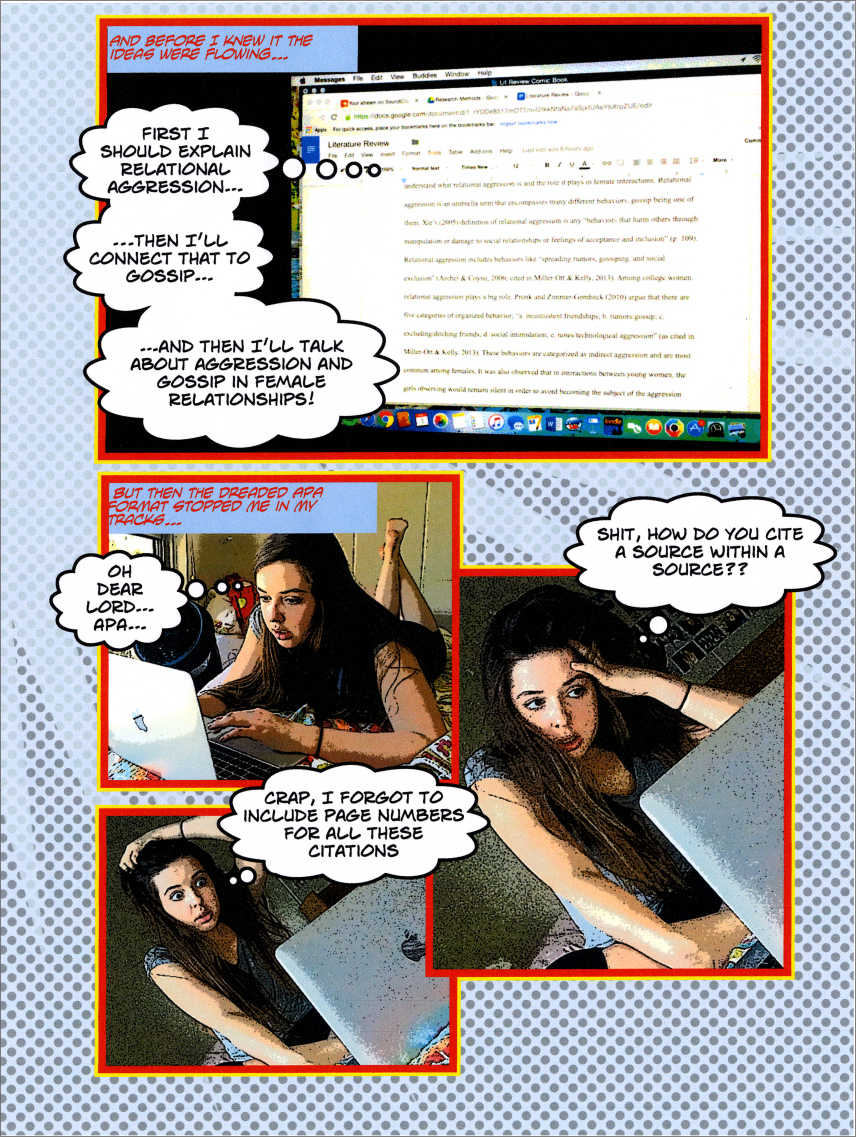
Willow Wittliff’s comic also uses scatological references to address her fears, confronting them, and sharing them with us. Consider the imagery. In the narrative box, APA is characterized as “dreaded,” which brings the plea for divine help (“DEAR LORD”). The profane (“SHIT” and “CRAP”) are linked to the student’s own shortcomings of knowledge.
How to interpret the comics’ use of scatological references? In order for guilt (e.g., not knowing APA) to be purified, Burke requires the use of body analogies for redemption to be complete. Thus, references to “shit” and “crap” are ways for the trickster to be expressed to redeem Claire’s shamed shadow. Students’ first experiences trying to learn APA are often filled with error and low grades, and some initial shame over the lack of knowledge of how to correctly do APA. However, as represented in the comic, the use of shit and crap “describe learning through mistakes—a civilizing process” (p. 28). The bodily analogies of defecation are mortifying, but once expressed, are the path to the student’s redemption (Burke, 1966). Thus, the comic may be understood as an act of tricksterish freedom and creativity that allows the students to transcend shame. -
1
media/Red_ComicBG.jpg
2018-01-24T22:06:49+00:00
Paraphrasing
22
plain
2018-09-26T22:16:46+00:00
Nowhere is the student more clearly confronted with their own limitations than when faced with the task of paraphrasing, or, “rewording,” academic writing into their own words. Often the task of paraphrasing includes the use of a particular set of rules for how to “cite” the academic texts. In my class, students use the American Psychological Association (APA) guidelines. As the following representations suggest, the use of APA is a problem for students.
In Willow Wittliff’s comic, the use of “the dreaded APA format” is frustrating, raising additional questions about how the student should handle academic texts. The labeling of APA as “dreaded” raises the idea that this type of writing somehow possesses its own sinister divinity, at once awesome and awful. Thus Willow looks for divine guidance (“Oh dear lord… APA”) while feeling shamed by her lack of knowledge about how to do APA, and thus heaps profanities on herself (“shit” and “crap”).
Similarly, Claire Dobyn’s comic acknowledges the difficulty of writing APA citations, which she represents as “kicking [her] ass.” The idea that both APA and the “lit review” are entities with whom the student battles is very clear (“This lit review is shitting on you right now when it should be the other way around”). In representing the battle between the "lit review" and herself, Claire faces herself in her mirror, pointing an accusing finger at herself, knowing she needs to motivate herself. The metaphor of being “shit on” expresses ideas about power relationships. Who is shitting on whom?