Starting the Lit Review...
1 2017-12-12T17:39:48+00:00 LMU 7c67764c12c98f44dde9b0c909430ac1f143977f 1 10 Renee Samuelson plain 2019-05-16T21:13:54+00:00 LMU 7c67764c12c98f44dde9b0c909430ac1f143977fThis page is referenced by:
-
1
2017-10-11T19:23:53+00:00
“The Supreme Ordeal”: Procrastination
56
plain
2020-03-24T02:34:17+00:00
Comics address students' urge to procrastinate throughout the semester, which maybe a choice the student makes on a weekly, daily, even hourly, basis. Procrastination is "putting off for tomorrow what one should do today" (Milgram, Sroloff, & Rosenbaum, 1988, p. 197; my emphasis). In students' comics, showing procrastination is something that typically happens after "the call to adventure," and on "the road of trials," once the student begins the various assignments.
The theme of procrastination is a constant in students' comics and is sometimes put forward as the ultimate challenge that students face. In examining how students' comics represent procrastination, we find the expression of ideas related to both shadow and trickster.
Keep in mind, however, that the word "procrastination" is ideologically biased. Even when students admit that they are procrastinating, the word is always used in reference to schoolwork or something that someone else thinks the student should be doing. What is procrastination to the professor is a day at the beach for the student.
So, why do students procrastinate? For various reasons, including fear of failure, self-doubt, concerns with mistakes, lack of control, task aversion, high expectations for themselves, imposed standards of perfection by teachers, and criticism of others, including peers and parents (cf. Flett, Blankstein, Hewitt & Koledin, 1992; Milgram et al., 1988).
In comics, procrastination is shown in a variety of ways. In its most benign form, procrastination is depicted as a "reward" for work done, or merely taking a needed break in order to recharge for the work yet to come.
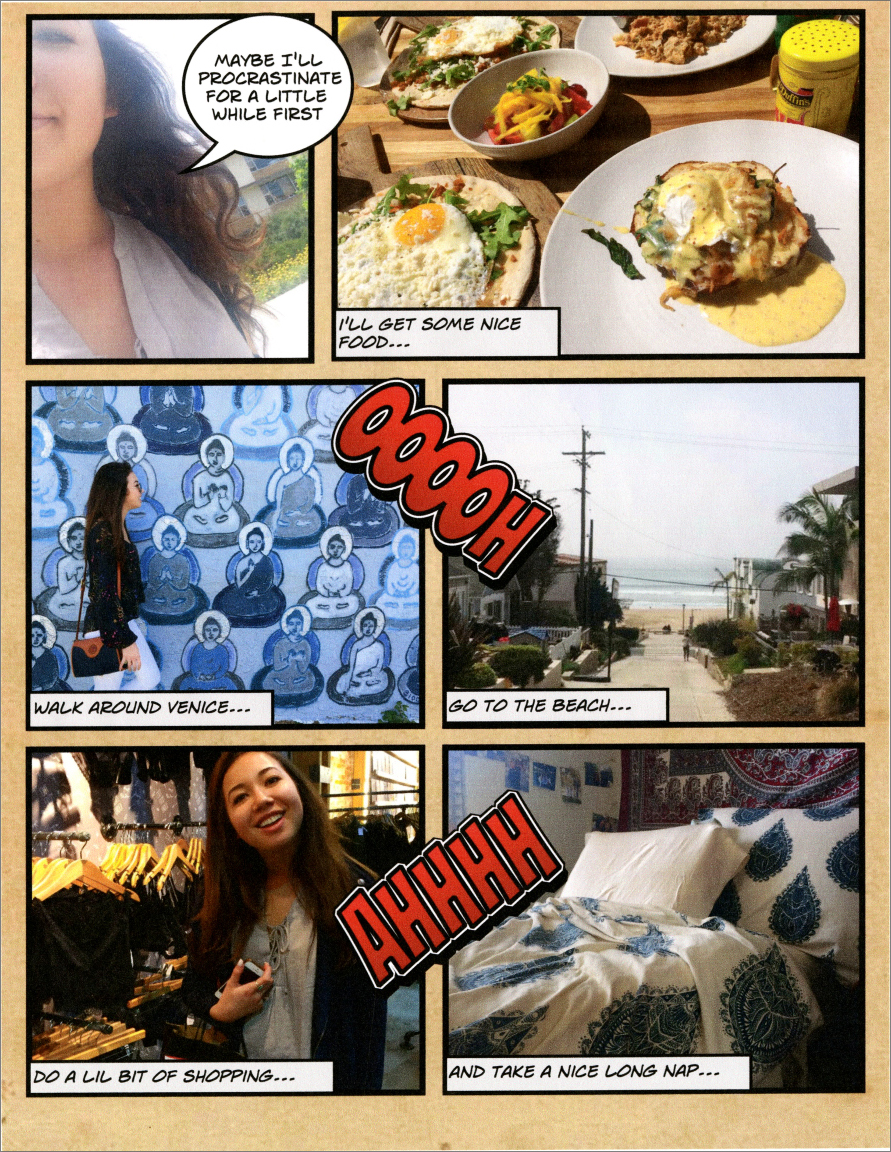
In Claire's comic, procrastination is represented as taking a break from the work that she knows she must ultimately do. It's just that there are other things she thinks she "may" do "first." Thus, what may be judged as procrastination, in its most harmless representation, may be just taking a joyous ("OOOOH AHHHH") break from academic work. The consumption of food and sleeping are all understood as pleasures preferred to schoolwork. Claire's depiction of procrastination is one of the few comics where procrastination is shown in a positive sense and is perhaps not even procrastination, but merely a reward the student takes for previous diligence.
In contrast, Jordan Philip's comic involves her choice about whether to join her friends or to continue working. In Jordan's comic, she offers some resistance to her friends' invitation to socialize ("You should come out with us! We're going dancing it will be so much fun!"). Importantly, Jordan's comic recognizes that she accepts the dominant ideology, and thus understands that she should not go out dancing, but rather, "should" continue to work on the assignments. On the other hand, the comic also supports Jordan's trickster sensibilities: she is in control of her world, makes decisions for herself, and enacts freedom of choice.
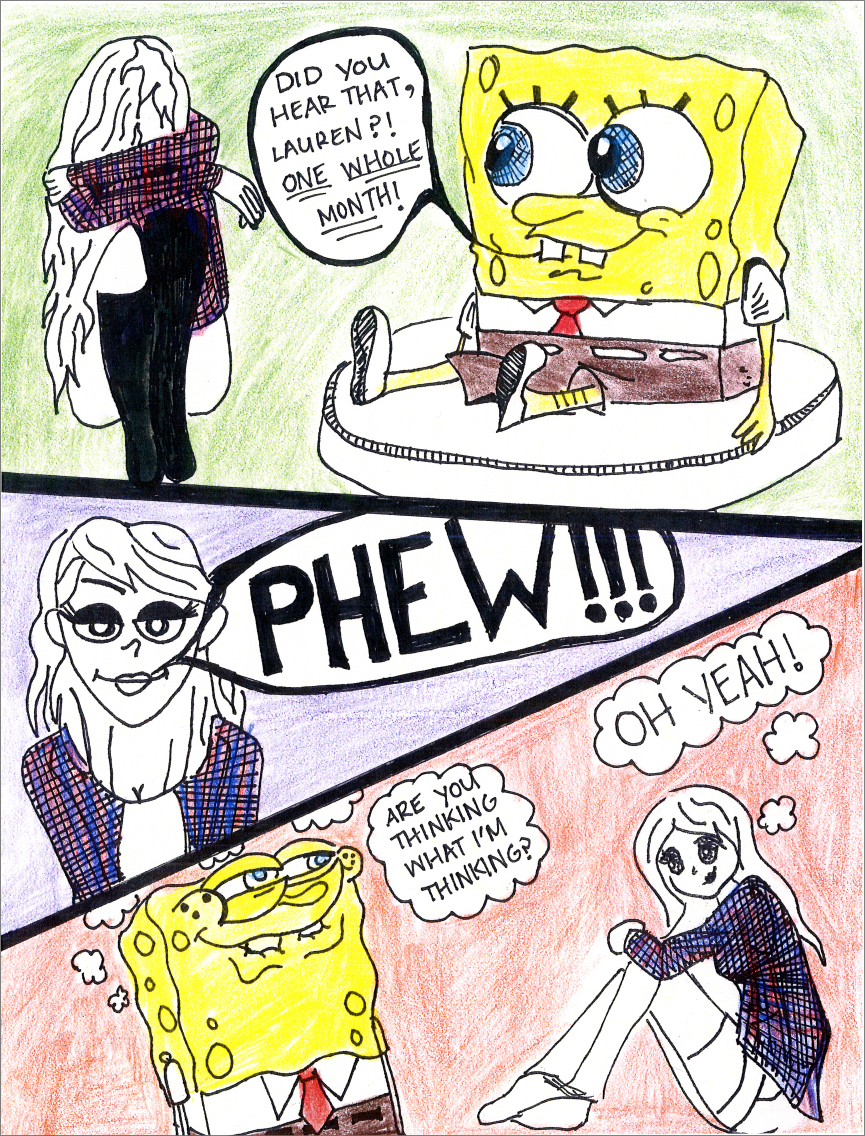
Lauren's trickster senses are further used in her comic when she and SpongeBob become accomplices in procrastination. Lauren's claim that "productivity is for suckers!" offers the counter-values to a more traditional ideology that suggests that students should make productive use of time. Lauren's comic says that people who adopt the dominant ideology are easily deceived "suckers."
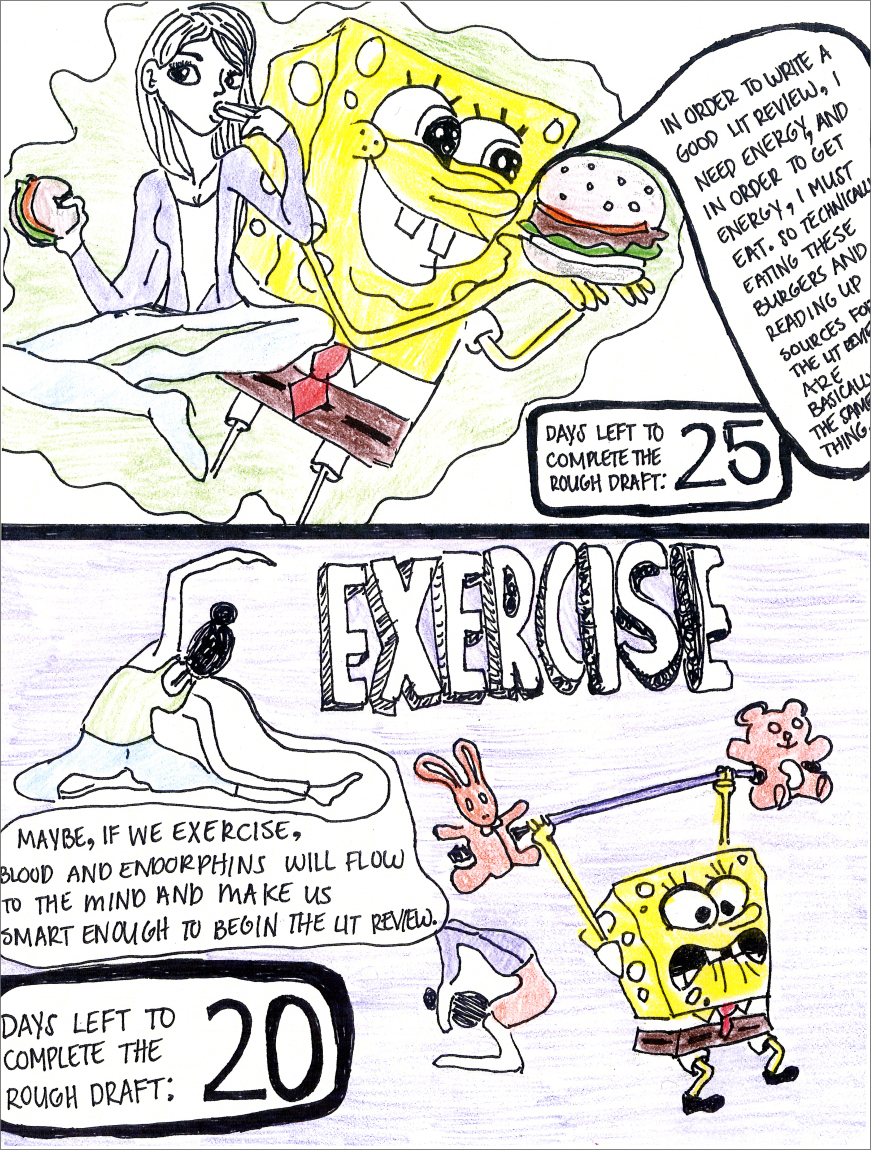
However, on some level, the traditional values are expressed and accepted. Even when SpongeBob and Lauren are eating burgers and exercising, the activities are superficially legitimated and are linked to the accomplishment of the literature review. Eating the burger provides "energy," which is needed and equated with working on the lit review. Similarly, exercise will provide "blood and endorphins," which will "make us smart enough to begin the lit review." Within the comic, the relationship between the mind and body is used to play with the idea of productivity; thus, even procrastination may be justified. Moreover, the tyranny of time provides a backdrop, with the "days left to complete the rough draft" evaporating.
After SpongeBob suggests that Lauren should return to work, Lauren rejects SpongeBob, which leaves Lauren to work on the lit review alone. This section of the comic is drawn without color, only in black and white. And when Lauren is asked to turn in a "rough draft" of the lit review, she is drawn as a skeleton, and announces to the professor that "I may be dead, but I have the rough draft." Lauren's symbolic death through the mortification of her own drawn body is an acknowledgment of her sin of procrastination. Again, the traditional ideology is acknowledged and affirmed in a humorous way.
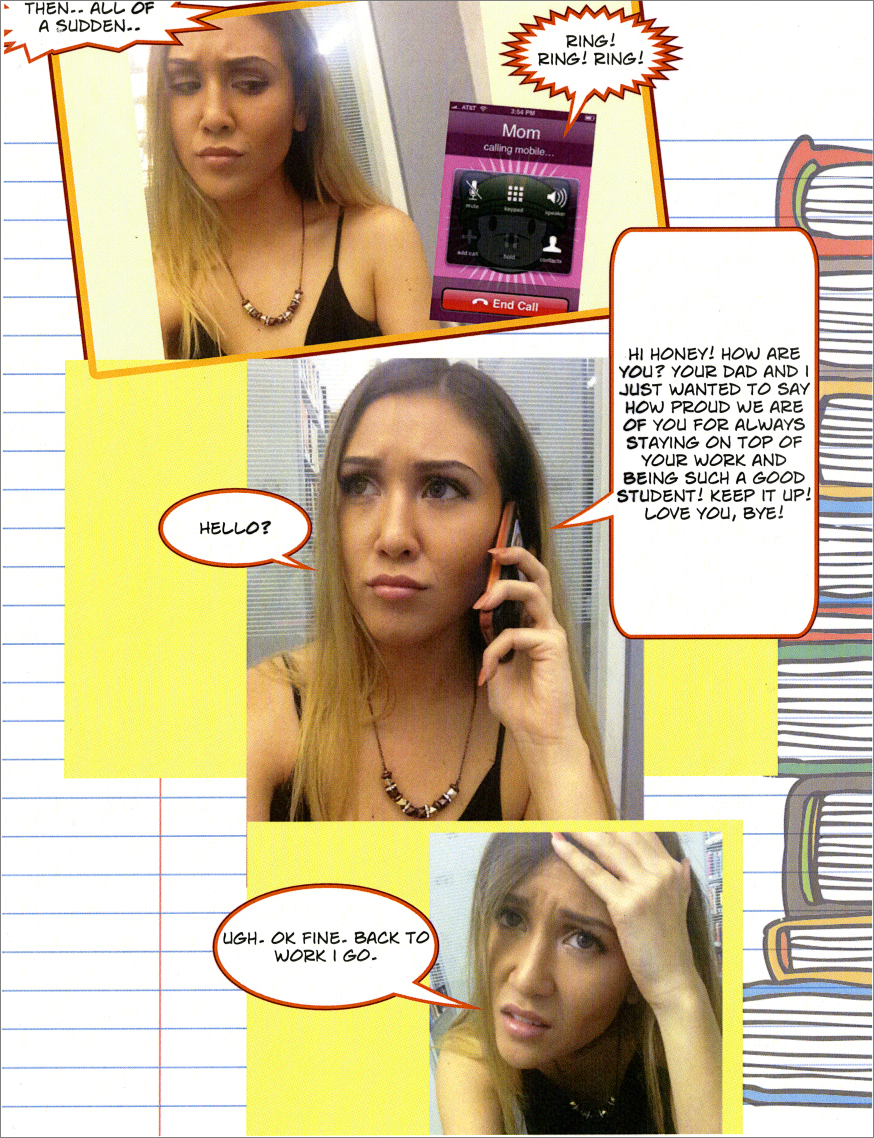
In contrast, Renee Samuelson's comic represents procrastination in terms of task aversion honed with a trickster's sexual metaphor ("Kay screw this. I'll do it later..."). However, the shadow is also represented with her guilt when her mother calls and tells Renee how "proud" they are of her "for always staying on top of your work and being such a good student! Keep it up!").
Parental pride works in opposition to Renee's initial task aversion, creating the social pressures to be the perfect student (cf. Flett et al.). Note the use of spatial metaphor. The student who is "on top of [their] work" is a "good student" and who should "keep it up." However, in Renee's comic, her parents' expectations only feed her insecurity about the argument paper. Ultimately, Renee grudgingly returns to work ("Ugh. Ok fine. Back to work I go"). The interaction takes place against a background of school imagery; the comic is set on lined paper and a stack of books.
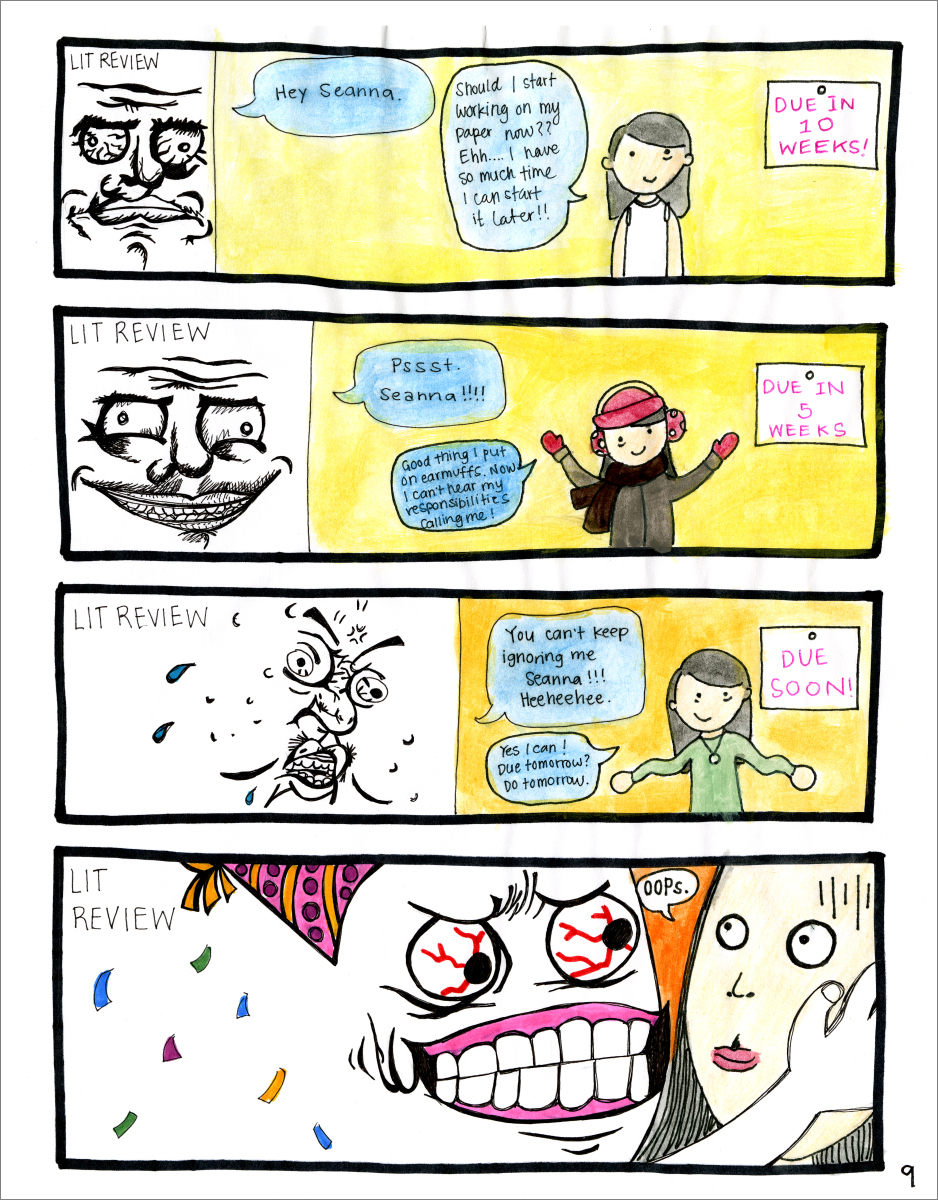
Monsters also may serve to push students into action. Seanna Duong's monster attempts to help her, urging her to stop procrastinating.
Seanna's comic's monster illustrates the theme of procrastination but also reflects back on the meaning of monsters. First, the monster arrives at a particular "cultural moment" (Cohen, 1996, p. 4). That is, the monster represents Seanna's desire to avoid her "responsibilities" for working on the literature review. Additionally, Seanna constructs the monster in a way to contrast the monster's growth with the ever-shrinking amount of time available for Seanna to complete the lit review. In this sense, the monster "always escapes" (p. 4) from the comic's panels, pushing into space in which Seanna is located. Finally, in contrast to other monsters, Seanna's monster "refuses easy categorization" (p. 6). Seanna's monster laughs ("Heeheehee") even as she continues to evade the monster ("sneakawaysneakawaysneakaway"). And in turn, Seanna does not really fear the monster.
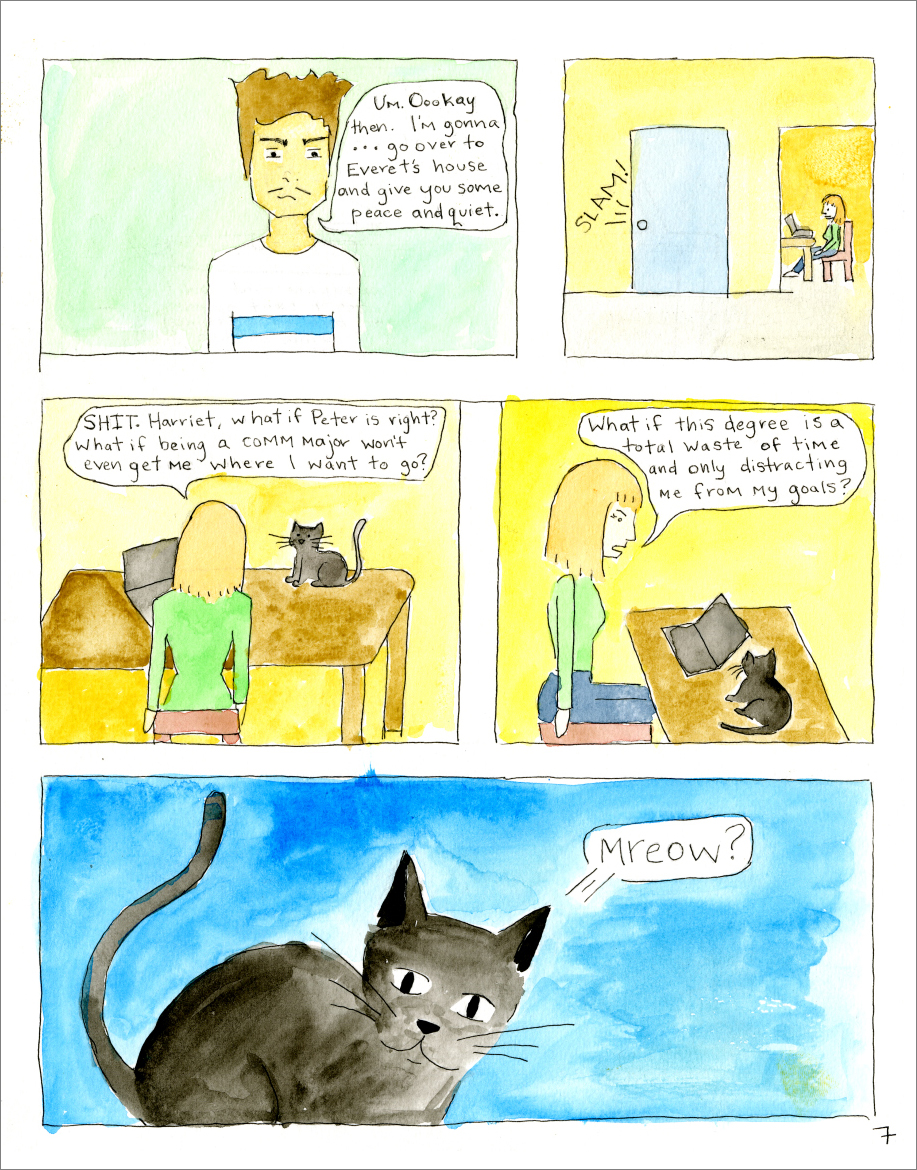
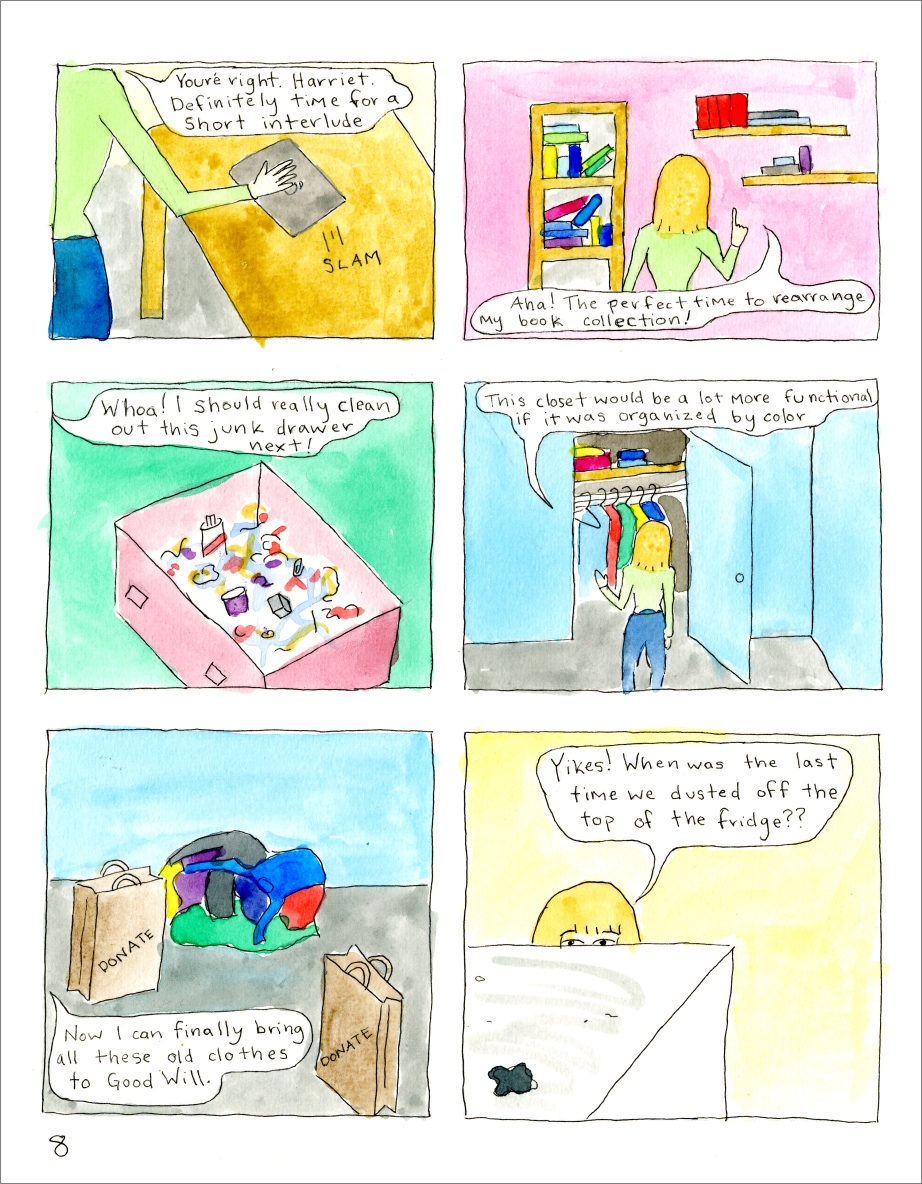
In Maria Nelson's comic, the procrastination from her literature review begins with Maria's cat, Harriet. Animals have long been used as images to represent idleness. The image of the lazy cat, "who wants to catch a fish but doesn't want to get its feet wet," is an icon of sloth (Wenzel, 1967, p. 105). And we might think that the cat's sloth is a substitute for Maria's own sloth. And sloth is linked to the shadow (Meyer, 2003). However, even when Maria takes a break, she does household tasks: rearranging her books, cleaning, organizing.
The idea that Maria is "perfect[ing]" her environment and is simultaneously not working on her literature review raises the idea that perfectionism might be linked to procrastination. And in fact, a number of research studies have pointed to this (e.g., Flett, Blankstein, Hewitt, & Koledin, 1992).
As the mythic journey plays out, heroes face a "supreme ordeal," which may be an "expansion of consciousness and therefore of being" (Campbell, p. 246). In this sense, while students may view the literature review as "the enemy," the real battle is something that is internal, something within the student.
I am the person whose assignments are the symbolic bread crumbs that the student must follow in order to finally finish the literature review. And so, a student's deviation from the path—her procrastination—is understood. My assignments contribute to students' stress and "task aversion." They anticipate my disapproval, fearing that they should meet what they take to be my imposed standards of perfection (Flett, et al., 1992). Students find the task difficult. They want to be perfect but anticipate that they will fall short. So they procrastinate.
A final word on procrastination. For this book, I chose images that worked for my analysis. I also mostly selected from the comics I found to be witty and detailed, the best comics. In contrast, some students' comics were profoundly lame, boring, and unimaginative. In such comics, the entire doing of the literature review was represented as one long episode of procrastination. Not surprisingly, many of the worst comics were created by students who also wrote half-assed literature reviews. -
1
media/Red_ComicBG.jpg
2018-01-24T22:11:51+00:00
Perfectionism
20
plain
2020-03-24T04:55:34+00:00
Why do students procrastinate? Reasons include fear of failure, self-doubt, concerns with mistakes, lack of control, task aversion, high expectations for themselves, imposed standards of perfection by teachers, and criticism of others, including parents and peers (Flett, Blankstein, Hewitt & Koledin, 1992; Milgram et al., 1988).
In Renee Samuelson's comic, a call from her mom brings up the parental expectations about being a "good student," which means "always staying on top of your work." Thus, the student feels obligated to make her parents feel "proud," even though these expectations are a source of unpleasantness ("ugh") for the student. Thus, Renee's grimace and her head in her hands signal her reluctance to continue working on the literature review ("ok, fine"), even as Renee's parents push her toward being the perfect student.
Similarly, Maria Nelson's comic shows her making her world perfect through cleaning and organizing around her apartment, even as Maria procrastinates working on her literature review.
The student’s idea that they "should" be perfect—even when they know they are not—becomes a motive for their procrastination; there is a sense that the student is "rotten with perfection" (Burke, 1966, p. 16). And yet, somehow the student breaks through their "personal limitations," and continues to work on the lit review. This "is the agony of spiritual growth" (Campbell, p. 190).