League of Scheibels by Nouf AlMarzook (comic0016016)
1 2017-12-13T11:42:53+00:00 LMU 7c67764c12c98f44dde9b0c909430ac1f143977f 1 10 plain 2019-04-08T19:28:13+00:00 Linta Kunnathuparambil c697ee746e94e40cf23561ddfe467f37d083a1a8This page is referenced by:
-
1
2017-10-18T20:52:56+00:00
Apotheosis: Becoming a God
90
plain
2019-03-07T19:18:34+00:00
Apotheosis is the deification of the student hero, in which the student becomes a “godlike being,” entering a “divine state to which the human hero attains who has gone beyond the last errors of ignorance” (Campbell, pp. 150-151). Within students’ comics, this is a climactic moment, where the character is most joyful, where the oppressive burden of writing the literature review has been removed. Although most comics do not make specific references to god, some do.
Humility generally prohibits students—all of us for that matter—from announcing they—or we—are gods or even godlike. However, students are able to achieve the divine state by borrowing from the comic universe of “superheroes,” who serve as godlike stand-ins (e.g., Wonder Woman, Superman). Superheroes are often representations of the perfected beings whose “devotion to justice” suggests the analogy of “earthbound gods” (Reynolds, 1994; see Hatfield et al., 2013, p. 106). Variations of apotheosis or deification are represented in different ways. Some are modest, simply using the word “super.” An example of this would be Juliet Sivori’s title for her comic, “Super Student,” which suggests the comparison to a “superhero.” However, other students use images to identify with superheroes.
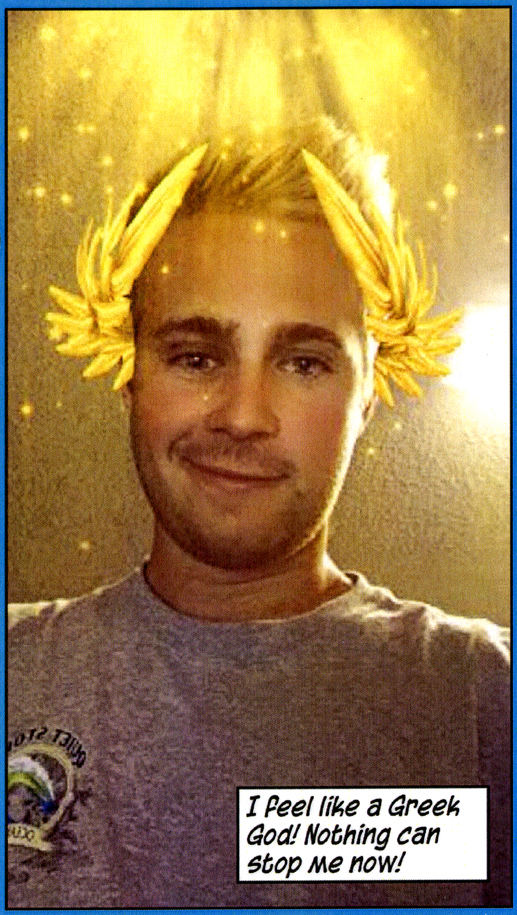
Wearing a wreath of golden leaves and bathed in golden light, Valente Dolcini’s comic suggests the metaphor of the Olympics, with Valente comparing himself to a “Greek God.” And the wearing of leaves in “pagan” times suggests the association between the tree-spirits and the divinity of the wearer (see Sir James Frazer’s The Golden Bough for a discussion of tree-spirits).
Carina’s comic uses the victorious raised fist, which is simultaneously a punch, while delivering the onomatopoetic “POW!” which is set in an explosive typeface and enclosed in an energized and spiky balloon. This type of image is a staple in superhero comics, and most notably, used in a campy fashion in the Batman television series of the 1960s. In Carina’s comic, the word “POW!” expresses the symbolism to show her defeat of the enemy literature review.
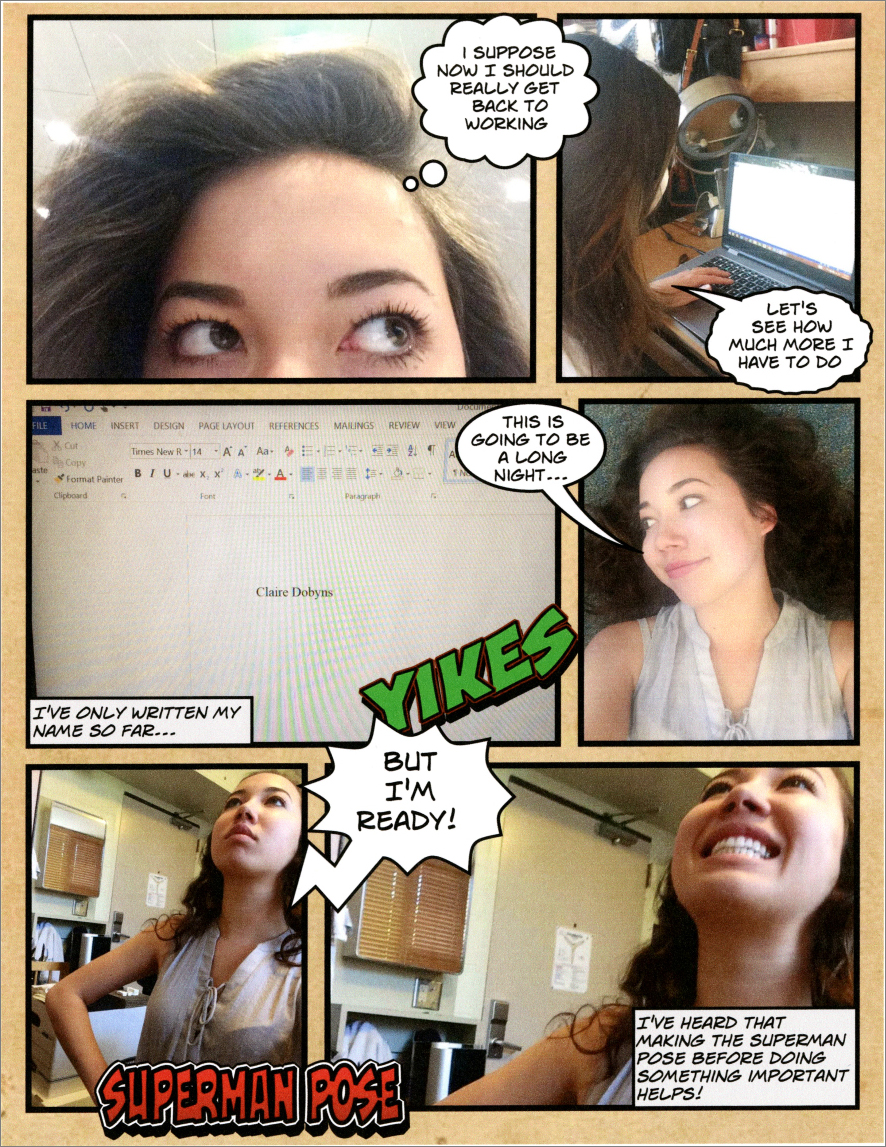
Similarly, in Claire Dobyn’s comic, Claire strikes what she labels the “Superman pose,” with her hands on her hips, which references a pose associated with Superman, and suggests Claire’s willingness to meet her challenge. When Claire strikes the pose of “Superman” she imagines herself with the power and strength she feels she needs to finish the lit review. By “mirroring” Superman, Claire gains “control over the environment,” and eliminates her shame (Bassil-Morozow, p. 60). This is the trickster striking a god-like “pose,” knowing that it is a pose, that she really isn’t Superman, but that the pose may still provide some sort of psychological help. Thus, the mirror serves as a “metaphor for the unsteadiness of self-perception” (El Refaie, p. 67).
This also suggests of a sense of atonement with her god, in that she is modeling the strength of a classic superhero, Superman, to provide a psychological boost that will allow her to accomplish the task. This becoming “at one with” her god also suggests that Claire is combatting her earlier fears.
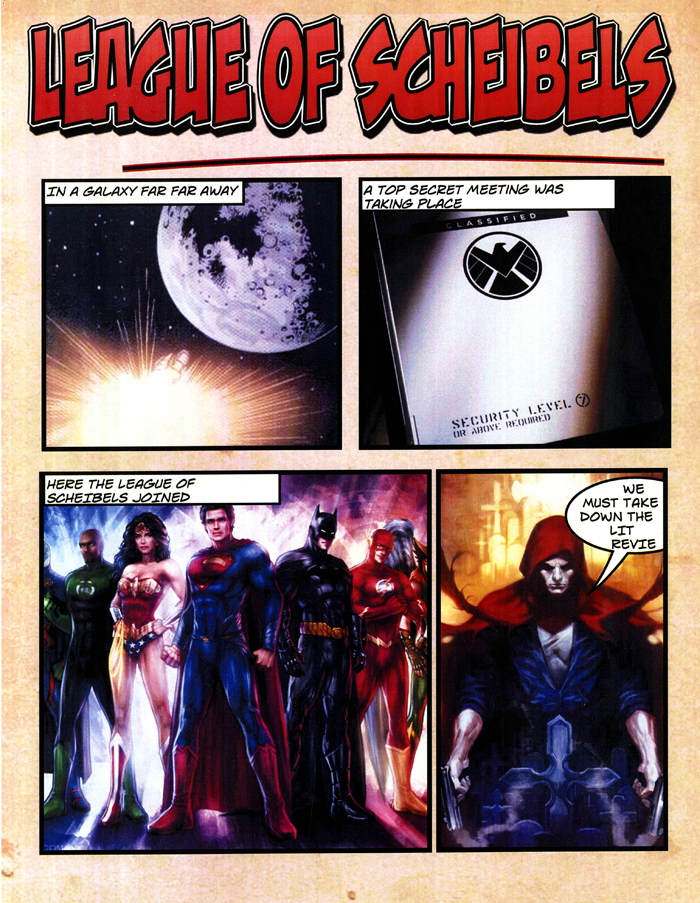
The final example of a student becoming god-like (aka “apotheosis”) is noteworthy because the student’s comic uses of the superhero genre of comics, which is often considered as modern mythology (see Duncan, Smith, & Levitz, 2015; Chap. 7; Hatfield, Heer, & Worchester, 2013). In the world of comic books, the “superhero” genre has been a near-constant presence, and “teams” of superheroes have been credited with re-energizing the superhero genre and developing a comic book “fan movement” (Duncan, Smith, & Levitz, p. 305). Within this group, Detective Comics’ Justice League of America (JLA) was created first in 1960 (Duncan, Smith, & Levitz, 2015, p. 305), and includes such superheroes as Superman, Batman, Wonder Woman, Flash, Green Lantern, and an assortment of guest superheroes.
Nouf AlMarzook’s comic uses the process of doing the literature review as a key element for creating a mythic epic in which a group of superheroes battles a group of supervillains. And Nouf’s approach marks the creativity and boundary-breaking of the student’s trickster, where “the raw energy of the new struggl[es] to break through the surface of old structures. It is a metaphor for change” (Bassil-Korozow, p. 31). That is, Nouf breaks free from the constraints of my assignment to create a comic by recreating a popular comic form.
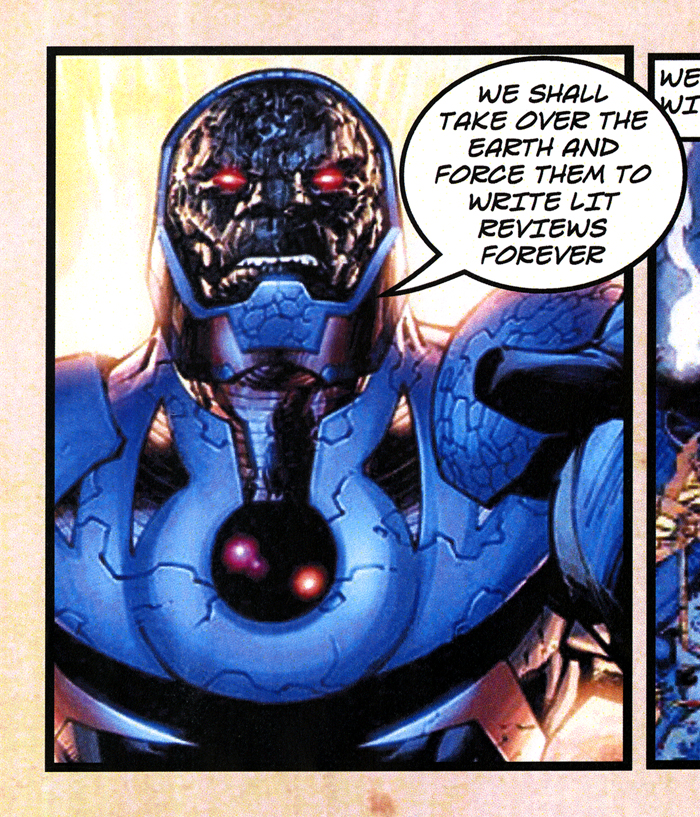
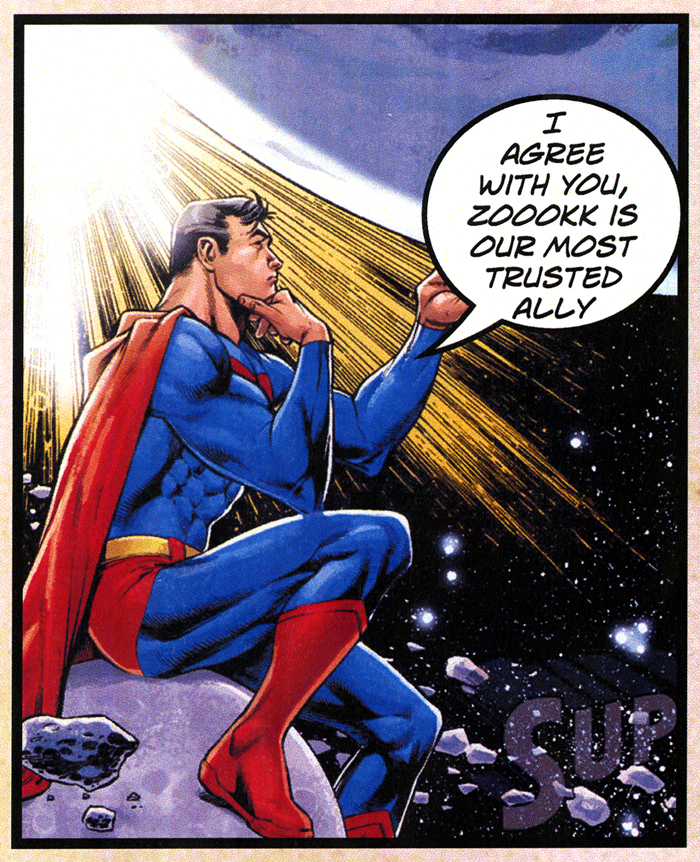
In Nouf’s comic the “League of Scheibels” is opposed by an equally powerful group, “The Villains of the Lit,” who seek world domination. Nouf’s choice to name the superheroes (“League of Scheibels”) and supervillains (“Villains of the Lit”) seem to suggest “shared common origins” and commonality of substance, both related to the actual class assignment, the literature review (Hatfield, p. 149). In some sense, the “Villains of the Lit,” is both the nemesis of the “League of Scheibels,” but is also a “distorted shadow” (Hatfield, 2013, p. 136; cited in Hatfield, Heer, & Worcester, 2013).
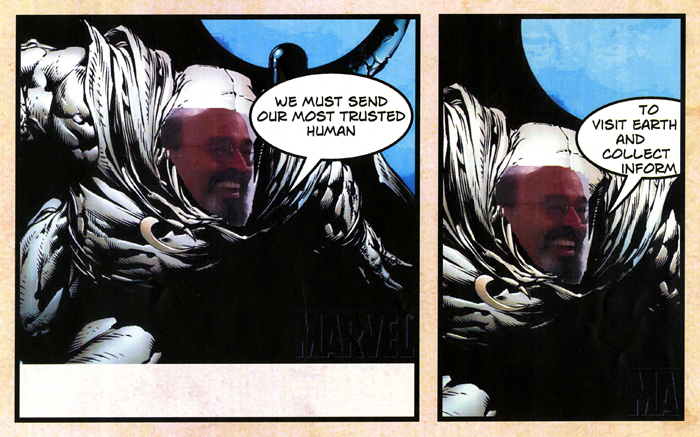
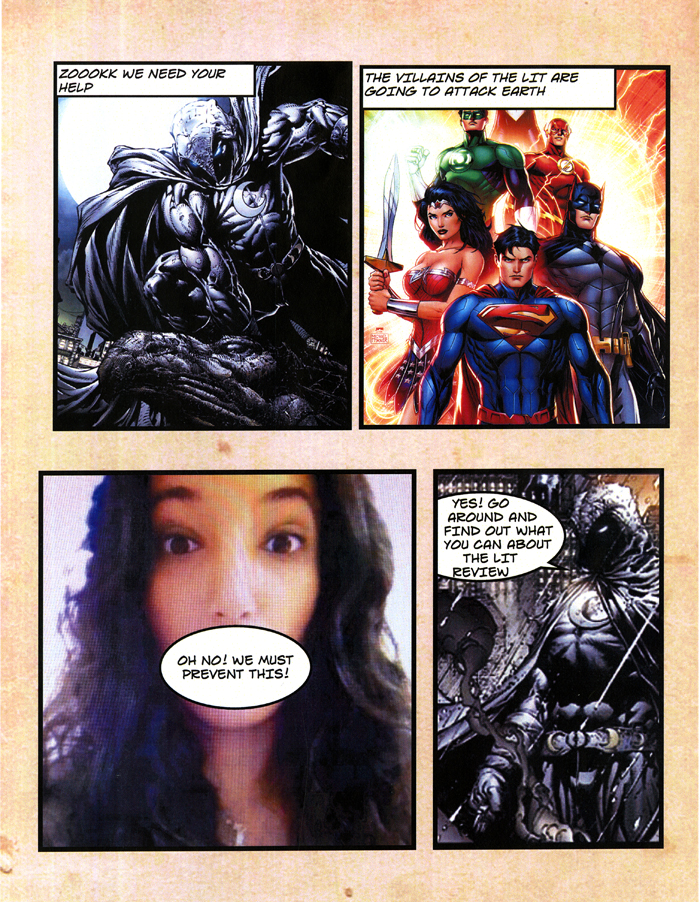
In Nouf’s story, the League of Scheibels is led by “The Scheibel,” who is embodied within another comic superhero, “Moon Knight.” In Nouf’s comic, my face is superimposed on Moon Knight’s massive, muscled body.
Moon Knight’s logo/image is that of a crescent moon. Nouf’s use of Moon Knight to lead the League of Scheibels creates identification between the student (Nouf) and the professor (me, aka “The Scheibel”). The image of the crescent has symbolic import in the Arabic culture, and Nouf is of that culture. Thus, by combining my image with that of the crescent, Nouf creates common substance between the two of us; beyond being student and teacher, Nouf and I share, in the comic, Arabic identity.
It is worth noting that Moon Knight is a rather severe anti-hero, one prone to extreme violence (e.g., carving a crescent into his enemies) and mental disorders, including schizophrenia. I am not sure what prompted Nouf’s decision to create my character in this manner. I have been told that I am sane. Really.
The Arabic origins of Moon Knight’s fictional biography is intertwined with actual Ancient Egyptian theology, in which the god Khonshu is the “god of the moon.” In the fictional biography of Moon Knight, the human character, Marc Spector, becomes “Moon Knight,” who becomes Khonshu’s “avatar on Earth” (see Wikipedia’s entrée for “Khonsu”). The end result is that the professor (me) is raised to the status of “god,” although a violent one.
Like many superhero comics, Nouf’s comic adheres to various conventional themes. A community is being threatened and needs to be defended, while the heroes battle the villains. In Nouf’s superhero universe, the literature review is not merely a hard assignment. Rather, it has become a supreme form of punishment, one that will enslave Earth’s population for all eternity. This is appropriate; if the comic pits two opposing groups, superheroes and supervillains, then the stakes of the battle must be of supreme importance (cf. Burke, 1966).
In the comic, Zookk is the League of Scheibels' “most trusted ally.” Allies are a common type of character in superhero comics (Coogan, p. 87; cited in Heer & Worcester, 2009). At the beginning of Nouf’s comic, Zoookk is not a superhero, but she is more than human. As an ally, Zoookk has a liminal status, existing somewhere between human and superhero. In order to find out more about literature reviews, Zoookk is sent by Moon Knight to “find out what you can about the lit review.” Visiting my classroom “she mingle[s] with Earthlings to find information.”
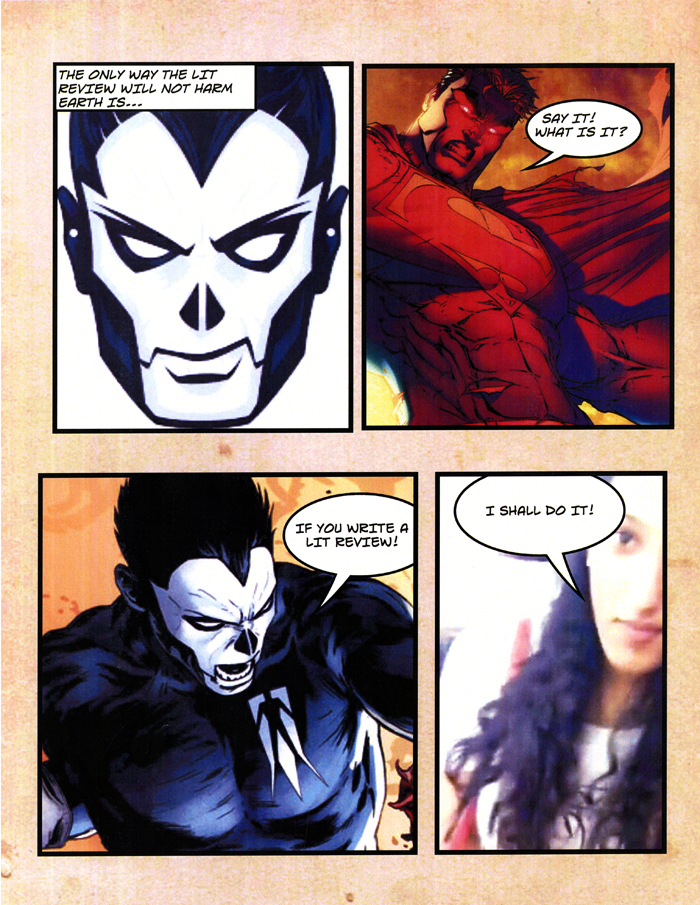
An initial battle between the League of Scheibels and the Villains of the Lit leads to more threats from the Villains of the Lit, and to Zoookk’s ultimate test, that she must write a literature review. Consistent with the student experience of having to write the literature review, Zoookk’s character is willingly undertaking a mortifying experience, one that imposes structure, a mark of shame and the shadow. In one sense, Zoookk’s mortification at having to write the literature review is a symbolic death, which prepares her for rebirth.
Zoookk’s statement shows her strength of will and her sense of duty, both common themes of heroes (Duncan et al, pp. 206-207). The idea that writing the literature review will save the earth also presents an alternative to the “myth of redemptive violence”—a common way for order to triumph over chaos—Zoookk’s victory is done by symbolic means—the writing of the literature review (see Duncan et al, p 201; see also, Wink). Thus, Nouf’s comic poses a counter-value to violence, and that communication is an alternative to war (Burke).
After successfully writing a literature review, peace is restored between the League of Scheibels and the Villains of the Lit. However, Nouf’s comic complicates the relationship between the two opposing forces. Rather than having “good” defeating “evil,” the comic blurs the boundaries between the two groups. A final challenge is given to Zoookk. In order to assure Earth’s survival, Zoookk must humanize her nemesis, “The Lit Review.”
Metaphorically, the peaceful reconciliation between the warring groups of superheroes also signals the redemption of the literature review as an assignment. This seems to suggest that Nouf’s comic offers support for the dominant educational values. That is, Zoookk not only completes the literature review, but she is able to persuade others that “the lit review is not bad.” After all the pain and grief associated with the process of doing the literature review, Nouf, like many students, seems to acknowledge—at least in her comic—that something has been gained (“the literature review is not bad”).
Nouf’s comic transcends the genre of superheroes in some ways. One of the critiques of comics that pit groups of superheroes against supervillains is that the groups seemed “locked into their own feuds with little connection to or concern for the world of ordinary humans” (Duncan et al., p. 211). In contrast, Nouf’s comic merges the genre to the everyday life of students. Moreover, Nouf’s comic is consistent with Campbell’s journey: an ally who is human (Zoookk), enters the world of divine beings, is sent back to Earth on a scouting mission to collect information, is ultimately challenged to write a literature review in order to save humanity, is asked to persuade people that “the lit review is not bad,” and is ultimately invited to join the League of Scheibels. Thus, Nouf’s comic does not resort to the “myth of redemptive violence,” but rather, is victorious by symbolic means, specifically, writing the lit review. Enemies are reconciled; war is avoided. -
1
media/Red_ComicBG.jpg
2018-01-24T22:16:01+00:00
The Superhero
24
plain
2018-09-26T22:54:41+00:00
Although students’ comics about writing the literature review resemble the autobiographical genre of “memoir” comics, the students’ self-mythologizing calls to mind the “superhero” genre. In such comics, students become “god-like.” In these myth-making comics, one student strikes a pose with her hands on her hips, a “Superman pose”; in another, the student wears an Olympian golden wreath and is bathed in golden light, suggesting the image of a god.
Some comics even draw on superheroes and super-villains to frame the student myth of doing the literature review. In Nouf AlMarzook’s comic, the student’s writing of the literature review is framed as necessary to save the human race from annihilation. And when Nouf’s comic alter-ego, Zoookk, successfully writes the literature review and defeats the “Villains of the Lit,” she is invited by a league of superheroes (“The League of Scheibels”) to join them, a god-like superhero.