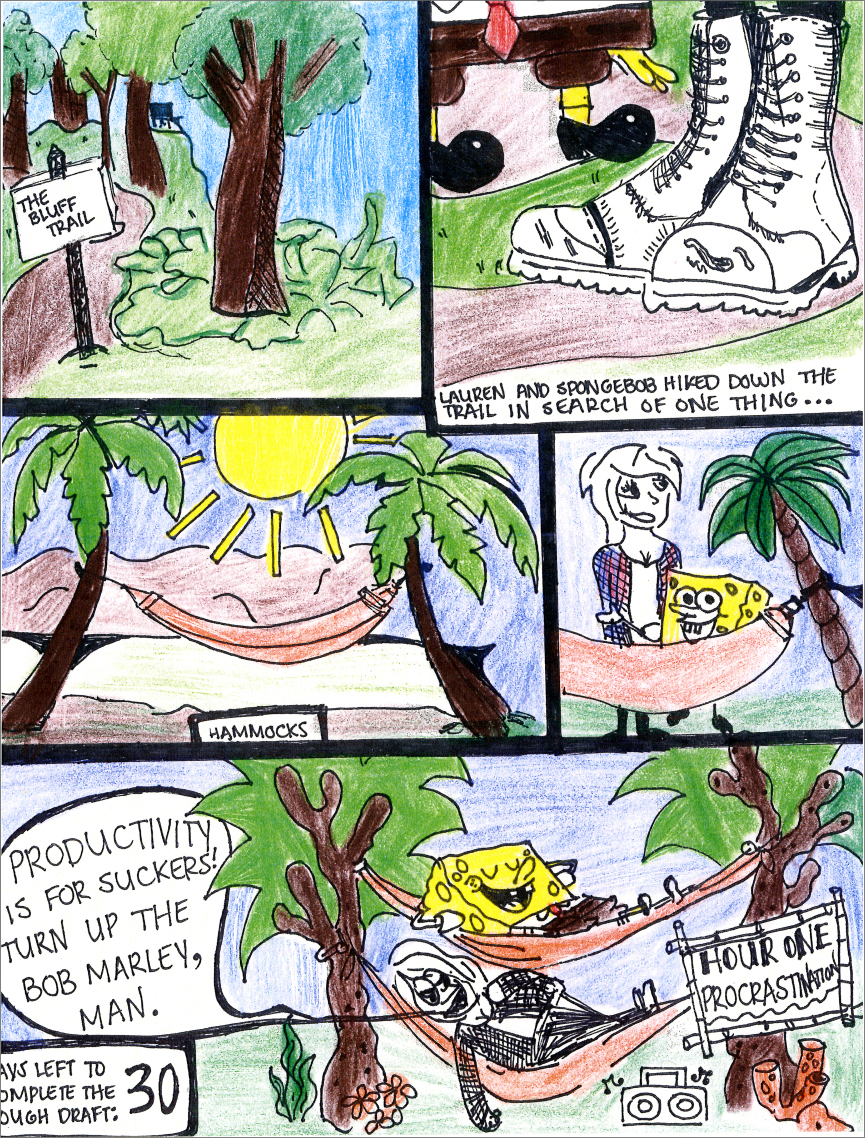
12018-03-16T22:54:38+00:00Susan Gardnerd75a28c6570c5c305a038bfe36f9b0334fdf86d612plain2018-03-16T22:55:13+00:00Susan Gardnerd75a28c6570c5c305a038bfe36f9b0334fdf86d6Librarian Commentary: Procrastination is a common theme in almost all the comics. I think it goes back again to students not understanding research is nonlinear. They expect to find, read, and incorporate their sources the night before the assignment is due, whereas more experienced researchers know to leave time for failure and eventual serendipity. One way for faculty to help with this problem is through scaffolding,or breaking the assignment into smaller portions and giving feedback on each portion.
This page is referenced by:
1media/Red_ComicBG.jpg2018-01-24T22:10:32+00:00Procrastination29plain2020-03-23T20:56:26+00:00Supernatural aids are not necessarily always helpful. Rather, they can be "tricksters" who may both help and hinder the student hero (see Bassil-Morozow, 2015). For example, in Lauren Delisle's comic, SpongeBob SquarePants both aids Lauren and leads her astray.
In her comic, the idea that the student has plenty of time to do the literature review may serve as a reason or motive for procrastination, for not doing the "productive" work needed to complete the literature review (e.g., "Productivity is for suckers! Turn up the Bob Marley, man").
Students' comics often portray procrastination as the "supreme ordeal" with which students must grapple. The supreme ordeal is an "expansion of consciousness and therefore of being" (Campbell, p. 246). This is where the student may come to realize that the real battle is not with the literature review; rather, the battle is internal, something within the student.
The idea of procrastination, from the perspective of the student, may simply be a well-deserved break from their labors. This may take the form of a nap, a meal, an afternoon of shopping for clothes, or an evening out with friends.
In Jordan Phillips' comic, the student recognizes that she "should stay in and work" on her literature review.The idea is that a student "should" do certain things (e.g., "stay in and work") in order to live up to the traditional expectations of being a good/serious student. Jordan's decision to not do what she "should" do suggests her recognition that she is "perfectly" imperfect and willing to give in to her inner trickster.