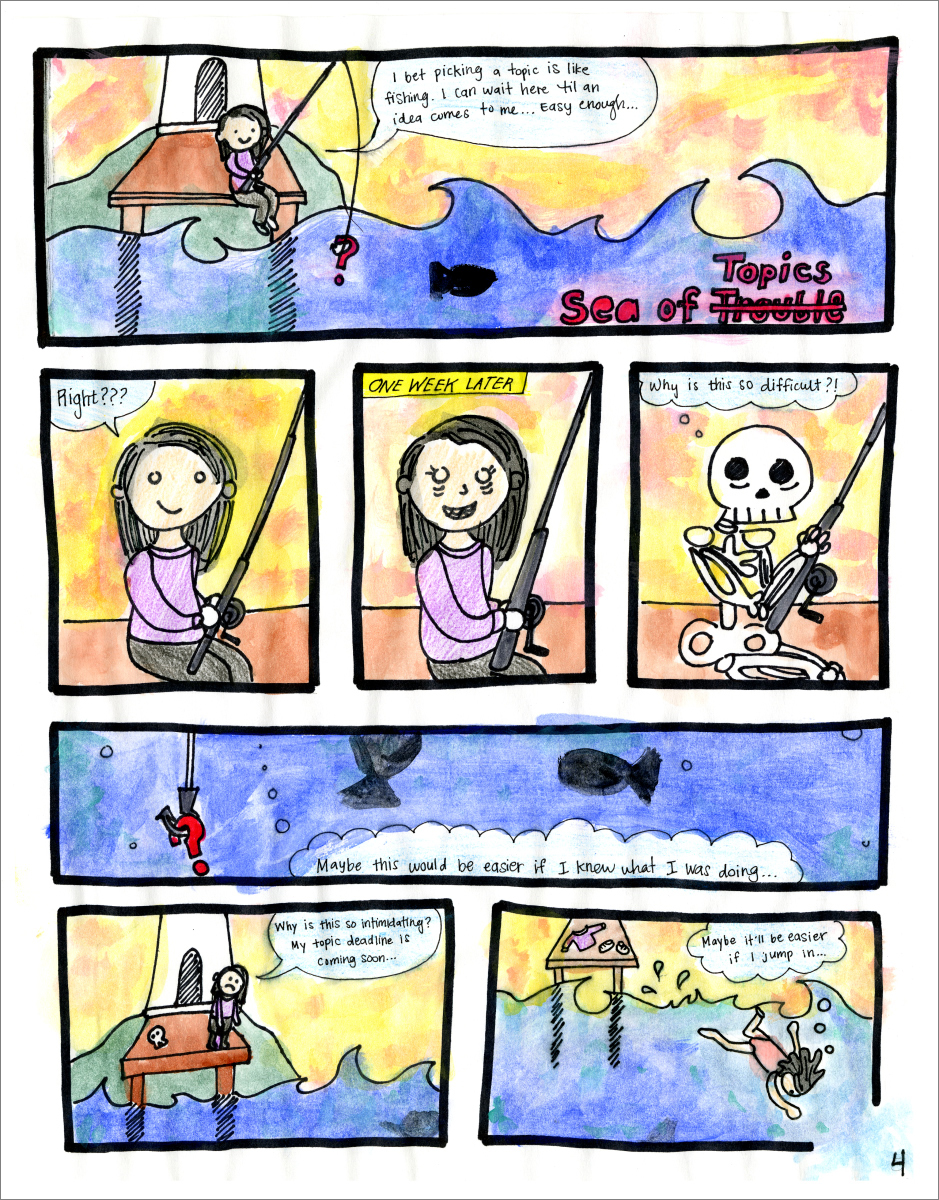
12018-03-16T22:18:24+00:00Susan Gardnerd75a28c6570c5c305a038bfe36f9b0334fdf86d612plain2018-03-16T22:19:07+00:00Susan Gardnerd75a28c6570c5c305a038bfe36f9b0334fdf86d6Librarian Commentary: Another positive learning disposition mentioned in ACRL’s Framework for Information Literacy for Higher Education is the critical self-reflection required to spend time exploring a topic with curiosity and an open mind. One of the biggest challenges for students is to choose a manageable topic that is not too narrow or too broad. Feedback from the professor on this front ensures that the student chooses a topic with the appropriate scope.
This page is referenced by:
1media/Red_ComicBG.jpg2018-01-24T22:03:09+00:00Finding a Topic27plain2020-03-23T20:22:31+00:00The first step on the literature review road is finding a topic. The topic is something that has already been studied. And students need to fine these published research studies. These studies—each of which contains its own literature review—will help guide students through the process of developing their own literature reviews. However, finding a topic is not an easy thing to do.
Seanna Duong’s comic represents her search for a topic to fishing, which she suggests includes an element of luck. However, this strategy turns out to be a bad idea. After a week, Seanna presents herself in the form of a skeleton, a metaphor for death. The skeleton humorously suggests death from old age. Fortunately, Seanna was able to find a topic that worked for her.
Sometimes students are able to find a topic by themselves. However, students often require help. As the teacher, I try to help them and to lead them to a topic that they might find interesting. I invite them to my office. We talk about what they find interesting, probing for possible topics. Maybe tattoos, or graffiti, or gossip, or romantic jealousy.