"The Refusal Of The Call To Adventure"
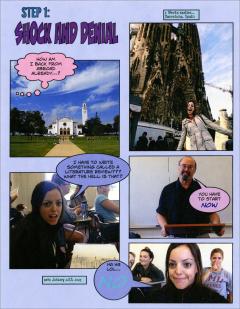
The prospect of grappling with a semester-long academic beast—the “dreaded” literature review—promotes no joy in the student-hero. And amidst the too-cool-for-school college social scene, it is easy for the student-hero to “turn the ear to other interests” (Campbell, p. 59). But—as the Borg says to the members of the Starship Enterprise—“resistance is futile.” And so, the students begin to take photographs, photographs that will document their resistance to the call to adventure, even as they are being shoved into that adventure.
Madelyn Ryan’s comic is organized by the “stages of grief,” referring to Kubler-Ross’ book, On Death & Dying (1969). Her flat refusal of the call to adventure (“No”) follows quickly on the student’s response to having to give up the easy life of vacation and the world they have left behind.
In Kubler-Ross’ scheme, anger follows denial, which is represented in Seanna Duong’s hand-drawn comic. Seanna’s pulling out of her hair is self-punishment, which suggests “mortification,” a means of purifying herself from her tension, her guilt. Why does Seanna feel guilty? Perhaps fear. Perhaps because she has to do something she does not want to do, and she assumes she has few choices. But she recovers and accepts the existing power relations: student versus teacher.
In Justice Domingo’s comic, the refusal is glimpsed in Justice’s repeated images of negation and defeat: head bent in defeat, she has “nothing to write,” and questions whether she really even “need[s] to go to college.”
These are images of “refusal of the call to adventure.” Maybe the images are an exaggeration, maybe not. There is sincerity, because stress and fear are both part of what students experience. Justice represents herself as shamed and alone, her shadow-self subject to the demands of the literature review. On the other hand, Justice tells us of her fear, plays with it within the comic. [This (previous) sentence is off. Something is missing or the conjugation is incorrect.] If there is real fear of the task at hand, by the time she has finished the lit review and creates the comic, Justice’s inner trickster knows that she can now control how her situation is represented in the comic.
Consider Lauren Delisle’s first-week comic, titled “The Prophecy,” in which “prophecy” suggests the “influence of divine guidance” (Guralnik, p. 1139), a theme that will be evidenced in many comics.
Note the “refusal of the call to adventure,” as Lauren awakes from a nightmare. From the perspective of the student, being told on the first day of class that the semester will end with the completion of a devilishly difficult assignment is not what students want to hear. Thus, Lauren’s waking from the dream screaming “Nooooooo!!” is similar to Madelyn Ryan’s comic. A refusal to engage.
Additionally, the comic extends the problem of doing the literature review. The problem is spread throughout students’ existence, including not only her conscious life, but also the realm of the unconscious, where mythic images may gather before springing to life in the pages of a comic. Students dream about it, have nightmares about it. The assignment is associated with the professor, who is represented within the dream as the devil, and who is scapegoated as evil. However, the evil emerges from the divine “prophecy,” which provides the student with some sort of guidance. In a sense, the professor is a stand-in for the literature review. And let’s remember that the devil is a stand-in for the serpent, who represents knowledge (see George & George, Chap.7). The depiction of the “dark side” is not limited to devil images. Thus, sometimes the dark side is shown through words, particularly “Muahahaha,” which represents evil laughter, and is often used in comic books by the villain.
The shadow is the trickster’s opposite and is dark where the trickster is light, or “lit” (Bassil-Morozow, p. 53). The shadow is rigid, controlling, and structured. That sounds a bit like the syllabus for my course. “Muahahaha” indeed. The key thing, at this point, is to recognize that in students’ comics establish by the light and dark, the trickster and the shadow, as characters in their stories. And that these “characters” are projections of the student. They represent internal conflicts that the student does not want to initially face or acknowledge (George & George, pp. 290-291).