Paper Trials: Preliminary Assignments
The first of the preliminary assignments is the "annotated bibliography." In this assignment, I ask students to find basic information from five different academic journal articles related to their topic. The students answer a series of questions: What is the article about? What are the central concepts discussed by the author? What types of arguments does the author make in the first paragraph? What evidence does the author use to support the argument? Then I ask students to write a short paragraph that cites all five sources. This is assigned to help students realize the importance of being able to combine or synthesize information from various academic sources.
In the next preliminary assignment, the "arguments paper," students go through one research study and identify and discuss arguments the author makes. Typically, this involves such things as identifying how the author of the academic source uses information from other sources the author cites. This also includes identifying the "limitations" that those other authors discuss about the work they are using. This requires students to cite "sources within sources," which ramps up students' anxiety about citing academic sources using APA style guidelines. You can imagine how confusing it is for students to dig out this sort of information. In both assignments, a student has to find information from journal articles that is relevant to the literature review, the student will later write.
Students' comics represent the "road of trials" in different ways. Some stories show the student quickly handling the two assignments as non-problematic, while other comics show the assignments as more problematic. These differences in story-telling are shown in the following three comics.
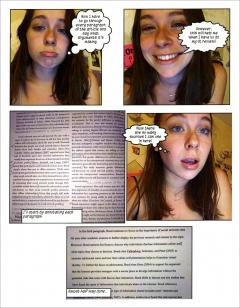
In Scarlett Sanchez's comic, after deciding on a topic ("OMG, I have an IDEA! I will study FLIRTING as the communication phenomenon for class"), she quickly addresses the two major preliminary assignments. She finds "scholarly sources" which she summarizes for the annotated bibliography, even as she realizes that the same sources "will help for the arguments paper too!"
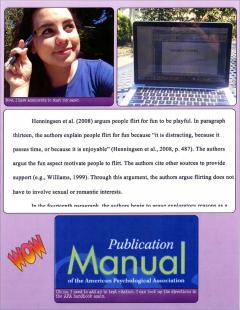
In her comic, Scarlett nicely combines images of the source she locates and the work she is doing, the finished annotated bibliography. She pauses to instruct the reader about her topic ("So, WHY DO WE FLIRT???"), demonstrates a couple of reasons why people flirt ("for fun" and "sometimes to boost self-esteem"). Following this, Scarlett gets back to work, and she shows us a bit of the paper that she has written.
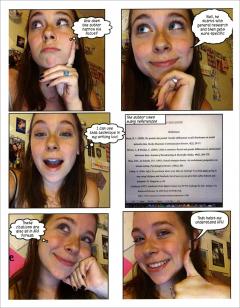
It is interesting to note that Scarlett's use of large block letters ("WOW" and "NICE START!") are similar in style to the "sound effects" that often accompany physical movement and violence in superhero comics and cartoons. Similarly, in Leah Morris, comic, Leah congratulates herself, acknowledging her abilities to see what is necessary, and is able to see her knowing as a path through the road of trials with which she is confronted.
In both Scarlett's and Leah's comics, students are represented as being in control; each confronts the task and accomplishes what is necessary and without much difficulty. There is a sense of ease between the student and the journal articles; the student is represented as being able to penetrate academic discourse, such that the "agonies of the ordeal are readily borne" (Campbell, p. 148).
There is no fear, no shame. In both Scarlett's and Leah's comics, both students show a dynamic playfulness in representing their work on the literature review. Scarlett's playfulness is directed toward the reader, letting the readers see the obvious fun ("Woo") she and her partner are having as they share the motivations for flirting, and letting the reader see her excitement ("Wow") about the work she is doing. Similarly, Leah repeatedly shows her comfort in the research process, breaking through whatever initial fears she may have had. Rather than being trapped by the assignment, by the journal articles, Leah exploits them ("I can use…") to her own advantage.
Of course, these are only the two students' representations of the process given to us after the tasks have been completed. Maybe Scarlett and Leah created these images to impress the reader, me, and now, you. On the other hand, maybe Scarlett and Leah are accurately representing their experiences. In either case, both comics support the values and ideology of the academic enterprise and of the university. Students accomplish what we say they must do. And the comics suggest a degree of pride for having done so.
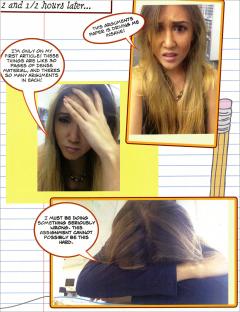
In contrast, Renee Samuelson's comic represents the "arguments paper" from a very different perspective. Renee's comic recognizes the equation in which the time and energy needed to accomplish the academic task takes a terrifying toll on the student's mental well-being. This is supreme stress, where the student's fear, self-loathing, and shame reach dangerous proportions. Faced with the "dense material" and the numerous arguments is represented as having a bad effect on the student's mental health ("this arguments paper is driving me insane!"). Ultimately, Renee assumes she is "doing something seriously wrong," psyching herself out. Renee's representation of her mental anguish represents the fear and shame and lack of control that is associated with the shadow image of doing academic work. And yet. Renee's decision to show this in the comic allows Renee to take control. She faces and acknowledges her struggles, her imperfection. The trickster trumps the shadow.
Thus far, the student-hero's journey has been represented as tasks on the "road of trials." These tasks have only been in preparation for more intense battles, in which the student hero will have to grapple with their internal struggles, which are projected outward as monsters and supernatural aids. However, the student may not even be aware of her connections to these gods and monsters and may not be aware of "that divine creative and redemptive image which is hidden within us all, only waiting to be known and rendered into life" (Campbell, p. 39). For the student hero, these projections are made real in their comics as representations of the literature review.