"The Supernatural Aid"
This section examines students' comics' depiction of a variety of supernatural aids. Sometimes, students represent their desire for "divine intervention" in the form of conventional religious deities (e.g., "God," "Jesus," "The Lord").
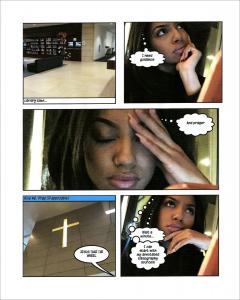
Jade's upward gazing eyes mirror a need for "guidance" in the form of "prayer," as she pleads for supernatural assistance ("Jesus take the wheel"). The image of the cross, carved into a library wall, also from Jade's perspective from below, suggests the divine nature of the power that will help her.
The image of the cross in the William H. Hannon Library is evidence that the library itself is a supernatural aid, something that assists the hero, providing advice and resources from the beginning of the journey. That the very shape of the cross is defined by the absence of a physical wall adds to the mystical and supernatural quality of its being.
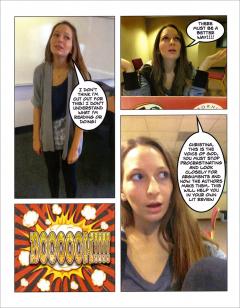
In Christina Gallo's comic, she is discouraged and confused. She looks upward with palms upward, asking for help. Christina first receives instruction from "the voice of God" who tells her to stop procrastinating and look for arguments. However, when Christina continues to complain, God instructs through tough love ("power through it, you wimp!"). This is the image of the supernatural aid prodding the hero to take action.
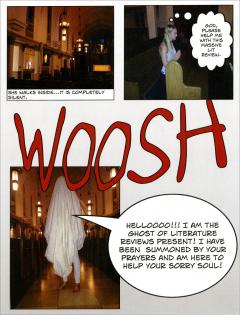
In both Jade's and Christina's comics, the student is helped by a supernatural aid. But even if the student reaches out to a more traditional deity, the student may be surprised. In the comic below, Madeline Jones asks for help from God in LMU's Sacred Heart Chapel, but she receives help from Charles Dickens' ghosts from A Christmas Carol, who will help her "sorry soul," and offers instructions on how to approach reading the sources Maddy needs to use in her literature review.
Although Maddy is initially fearful of the ghosts, she continues to be aided by them. The ghosts provide her with "spiritual energy" and necessary information to guide her and to help her complete writing the literature review (Campbell, p. 71). Maddy's encounter with the ghosts is shown in her dream, but the content of the dream is located in the real physical world of LMU; the photograph is created to suggest it was taken in the Sacred Heart Chapel, located on LMU's campus.
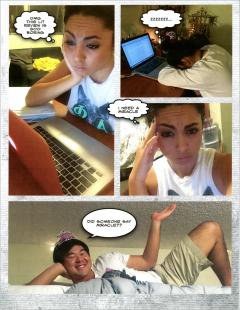
In Amanda Martinez's comic, she wishes for and is visited by a supernatural figure, the "motivation fairy." The image of the "motivation fairy" makes reference to literary figures, including Grimm's Sleeping Beauty fairy tale, as Amanda is sleeping when she enters the dream; the jeweled tiara suggests a fairy godmother, such as the one in Cinderella.
Despite these literary references, the "motivation fairy" represents the trickster's "licentious" behavior (Bassil-Morozow, pp. 24-27). On the one hand, "mojo" is a pun on "more joe," with "joe" being slang for coffee. But beyond that, the term "mojo" also signifies magical or sexual power, which suggests the presence of Amanda's inner trickster. The motivation fairy's pose on the bed adds to the sexualized image of the supernatural aid; significantly, the image of the motivation fairy both flirts and mocks with the idea of heteronormativity. In this sense, the trickster pushes our boundaries about what constitutes a supernatural aid.
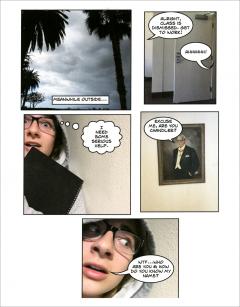
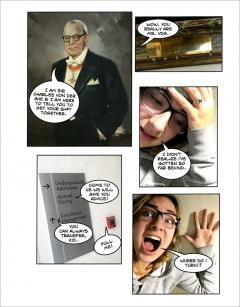
Students' comics may call up supernatural aids that are "local" to the scene. Thus, Chandler Wright's comic invokes a portrait of a university benefactor, Charles Von Der Ahe. The portrait is located in a building named for the same benefactor, who tells Chandler to "get your sh*t together."
Chandler's comic seems to make fun of, or at least to recognize the limited help of supernatural aids. "Mr. VDA" doesn't actually help Chandler, but has only given her advice. Other objects are given life and speak, but none are helpful. "Enrollment Management" tells her she can "transfer" to another university. In an echo of Alice in Wonderland, a fire alarm says, "pull me!" which Chandler does not do. After receiving no help, Chandler screams, "Where do I turn!?" There is a sense that supernatural aids may be of limited help to the student.
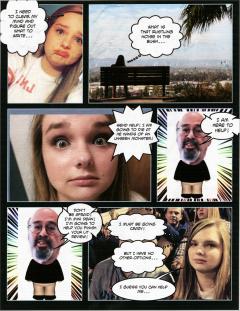
Supernatural aids may also suggest dangerous aspects of the trickster. In Quinn Heinrich's comic, titled, "The Magical Dean," the professor—me, Dean Scheibel—appears in a miniature form ("I'm Mini Dean"), who offers help to the student who is unsure of her topic.
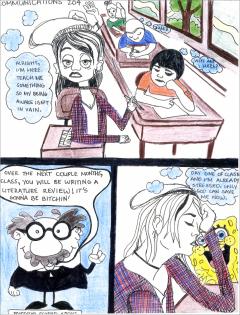
The professor may typically be viewed as someone who attempts to assist students, and the professor may be shown in a more-or-less "realistic" manner. However, that does not exhaust students' comics' representation of the professor. In Lauren Delisle's comic, I appeared as the devil. In a different vein, Quinn Heinrich's comic represented me as "Mini-Dean," a reference to a movie character who is a dwarf who functions as a jester-fool alter-ego for the movie's central villain. In linking the professor with villainy, power relations between student and professor are symbolically reversed; the student appears to have the upper hand. She is the student; I am the dwarf. But not completely. Supernatural aids may often be unusual in appearance. In this case, Mini-Dean appears as "some little fellow…to supply the…advice that the hero will require" (Campbell, p. 72). Further, in folkloric terms, a dwarf is "a little being, usually ugly or malformed, to whom magic powers are attributed" (Guralnik, p. 436). Linguistically, the term dwarf is associated with other terms meaning "to trick" (p. 436), and thus the dwarf seems to take on the magical aspects of the trickster.
Students' comics represent the teacher in various ways: as a helpful mentor who may appear as a supernatural aid. However, the supernatural qualities of the teacher also show a trickster who may appear as the devil. In this sense, the "dangerous aspect" of the supernatural is represented. Thus, there is a "mercurial" quality to the teacher's mentoring, which may be quick-witted, volatile, changeable, fickle (Guralnik, p. 888; see Campbell, p. 73). This is consistent with Campbell's ideas depicting the "supernatural aid" as helpful, but also devilish, even sexual.
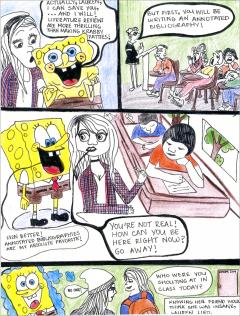
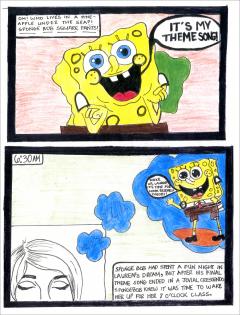
The trickster aspects of Campbell's "supernatural aid" are clearly displayed in Lauren Delisle's comic, in which SpongeBob SquarePants' loyalty and cheery optimism assists Lauren. And using an image with an ethos of childhood innocence serves to create an alter-ego of the student, who in the creation of the literature review, travels from innocence to knowledge.
SpongeBob SquarePants' initial appearance within Lauren's dream serves as a path toward "fulfillment" and "higher potential health" (Campbewll, 1971, p. xxii; see also Campbell, 1968, p. 82). In the first day of class, Lauren already feels stressed about having to write a literature review, thinks to herself, "only God can save me now." However, SpongeBob now presents himself to Lauren, declaring that "I can save you…and I will!."
As a supernatural aid, SpongeBob is visible only to Lauren. As a result, Lauren repeatedly questions the "reality" of SpongeBob's existence, which becomes an issue that divides them, despite the fact that SpongeBob repeatedly helps Lauren with the literature review. Lauren is unwilling to accept SpongeBob's existence ("You're not real! How can you be here right now? Go away!"). This may be viewed as a projection of Lauren's shadow-self, her perception informed by her previous knowledge about reality. Further, Lauren's recognition of this fact and her choice to play with this idea within her comic shows her trickster sensibilities; she drags her imposed limitations into the light of day and has fun with them within the context of her comic.
Monsters and "supernatural aids" seem to recognize the fears and hopes of students and appear in various forms. The supernatural aids are conjured by students for the purpose of appearing in the comics. As such, the images seem metaphoric. Again, the comics recognize the shadow aspects of the student experience, the lack of control. However, the comics also show the trickster side of students, in the creation of supernatural aids who take on mythic overtones and deal playfully with their own shadows.
Previously, the "monsters" that showed up in Sean's and Jordan's dreams were interpreted as "shadow" parts of the students. However, in the following two examples, supernatural aids seek to help the student and interpret problematic situations that the student encounters.
SpongeBob SquarePants first appears in Lauren Delisle's comic, where the character states that "he had spent a fun night in Lauren's dream." The phrasing suggests that SpongeBob functions independently from Lauren's character, that he has a purpose of his own. It is clear that SpongeBob is a helpful supernatural aid and knows that "it is time to wake her up for her 8 o'clock class." And even when Lauren shuns SpongeBob ("You're not real…Go away!"), SpongeBob continues to help her.
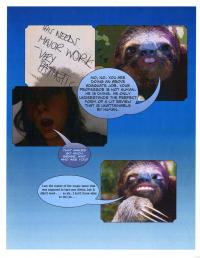
In Sabrina O'Mara's comic, she dreams that she meets her supernatural aid, a three-toed sloth. The sloth is a trickster, the animal version of "some little fellow of the wood" who lives in trees (Campbell, 1968, p. 72). Sabrina's sloth is a supernatural aid who offers her some protection after a draft of Sabrina's paper receives critical feedback from the professor ("This need major work. Very pathetic"). And the sloth helps Sabrina interpret the comment. "No, no. You are doing an above adequate job. Your professor is not human. He is divine. He only understands the perfect form of a lit review that is unattainable by human."
In this comment, we see the difference between professor (i.e., "divine") and student (i.e., "human"). More importantly, we see that the "lit review" is associated with "perfection," which is "unattainable" by the student. As will see in the next chapter, the issue of "perfection" is significant. In Sabrina's comic, the sloth's representation of a trickster juxtaposes the student's ability to become a god with the sloth's own limitations.
In myths, the supernatural aid supplies something that the hero will need on their journey (Campbell, 1968, p. 72). In this instance, the sloth had supplied the student with "magic sauce," which would have made the student "divine" and thus able to write the "perfect" lit review. The fact that the magic sauce "didn't work" is as it should be. The student may be aided by supernatural forces, but the transcendence from being human to becoming divine is something that the student must achieve on her own.
In the comics, students mostly show themselves awake, either working on the lit review or avoiding working on the lit review. In the comics, the students encounter images including religious deities, ghosts, a fairy, a dwarf, monsters, animals, and images of blood and water. Such images are universal "archetypes" that have become the symbolic inheritance of humanity, and part of our "collective unconscious" (see Campbell, 1971; Jung, 1971; Storr, 1983). These images, including those of the "trickster" and "shadow," are part of our mythic knowledge that are now commonly used terms in scholarly discussions of myth.
Students' comics also represent themselves as encountering tricksters and shadows in their dreams, which are "communications from the unconscious" (Storr, 1983, p. 17). Dreams might be considered as "fragmented myths" (Campbell, 1971, p. xxii). Dreams include compensations for things that the student may be avoiding in their conscious life.
Students are conscious when they are creating the dreams that appear in their comics. However, students may be drawing on their own dream experiences when they create the content of the comics. The images within the comics' dreams are related to the archetypes of the "trickster" and the "shadow." Thus the monsters that appear in Sean's and Jordan's depictions of dreams in their comics allow for the expression of the emotion of fear. As such, the monsters might be thought of as compensation for the students, allowing them to express feelings within a real-life context where needing to perform intellectual activity in the creation of the literature review). However, these same monsters also suggest the student's acknowledgement of a prospective future, where failure to complete the task would be linked to the symbolic death of the student (cf. Campbell, 1971; Jung, 1971; Storr, 1983).
The use of dreams within students' comics is important. Myths and dreams are profoundly connected, with "dream [being] the personalized myth [with] myth the depersonalized dream" (Campbell, p. 19). Students' comics, with the presence of ghosts, fairies, monsters, and comic figures, point to some sort of mythic connection. The fact that students populate their comics with characters who appear within the context of dreams all suggests that students use dreams rhetorically to recognize a mythic inheritance, even if the depiction of myth is done in a satirical, comic attitude.
This page has paths:
This page references:
- How to Survive a Lit Review: A Rule Book to Success
- A Lit Review Carol
- The Literature Review
- The Literature Review
- SOS: Lit Review
- The Literature Review
- The Literature Review
- Lauren And The Not So Leisurely Lit Review
- Lauren And The Not So Leisurely Lit Review
- The Magical Dean
- SOS: Lit Review
- Lauren And The Not So Leisurely Lit Review
- Tales of Sab and the Devine Lit Review God