Student Atonement With Their God
In Lauren's comic, the atonement between Lauren and the literature review is aided by SpongeBob and is accomplished through a blend of feelings and logic. SpongeBob's statement, "your wish is my command," is an allusion to another "supernatural aid," the magical "genie" who appears from a magical oil lamp. The genie's literary origins are in many stories, including Aladdin and the Magical Lamp, and has appeared in various cartoons and movies. In the top panel of Lauren's comic, the reconciliation is accompanied with little red hearts, symbolizing love.
Beyond the magic, wish-like suggestions, the word "genie" comes from the Latin word for "genius." Thus, the supernatural aid is a magical "spirit" but also possesses intelligence or "natural ability" or "genius" (Guralnik, p. 582). Beyond the allusion to the genie, the middle panel also makes reference to a drunk driving commercial, which has now been used in a variety of other contexts ("friends don't let friends…"). The final two panels provide a wealth of details that illustrate the atonement between Lauren and Spongebob. They both wear reading glasses—a metaphor for intellectual activity--and they are synchronized in their efforts to defeat the literature review (“Let's do this."). In the final panel, in which their presence is dwarfed by a giant computer keyboard, their collaborative success is celebrated with a noisy (“POW”) and a shared “high five.”
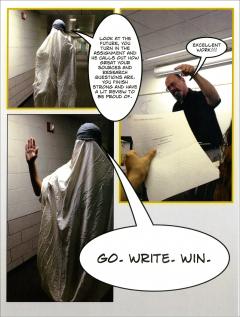
Another example of the student's atonement comes at the end of Madeleine Jones' comic, where she is supported by the three ghosts, her supernatural aids. In the comic, Madeleine's initial fear of the ghosts quickly changed, and it was evident that the ghosts were there to help her and provided aid to her throughout the process of writing the literature review. Now Madeleine is at the “threshold” of her journey. The supernatural aids can help, but ultimately, it is Madeleine who must write the literature review:
The ghosts' use explicit words, which are emphasized as three one-word sentences: "GO. WRITE. WIN." Each word is related to mythic concerns. "Win" is linked to words including "endur[ance]," "struggle," "desire," and finally, in Latin, venus, or "love" (Guralnik, p. 1628). The student becomes god-like, for Madeleine knows that she must love her enemy but must defeat it. Madeleine's divine rebirth is based on the gratification of desire: That in death, there is love.
Second, the word "write" traces its origins to older languages and words that mean "scratch," "tear," and "wound," all of which suggest that the act of writing is physical and not entirely pleasant, that pain is involved (Guralnik, p. 1942). Thus, winning is a contest and is something that is difficult. In order to "win," Madeleine must "write."
Finally, the word "go" comes from an ancient word that means "to leave behind" (Guralnik, p. 597). As Madeleine begins her final push to finish the literature review, "the transcendental powers must remain behind" (Campbell, p. 246). In order to "win," Madeleine must "write" by herself, without the help of supernatural aids.
In Seanna Duong's comic, atonement is shown in Seanna's psychological transformation that comes with her "abandonment of [her] attachment to ego" (Campbell, pp. 130-131). That is, Seanna's sin is her pride, and her ego-driven expectations regarding the literature review.
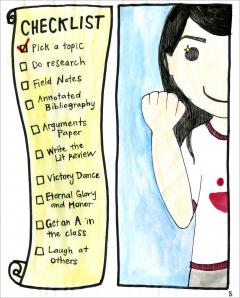
In Seanna's comic, her abandonment of her attachment to ego is enacted through Seanna's use of lists, which are their own form of logic. Each of the two lists suggests Seanna's orientation toward the literature review. And the symbolic death and abandonment of ego is demonstrated in the change of the content from the first list to the second list. Seanna's first "checklist" shows her unwarranted confidence, in which "writ[ing] the lit review" is merely a task on the way to her "victory dance," "eternal glory and honor," her "get[ing] an A in the class," and as a result, her being able to "laugh at others."
The comic's images are the counterpart to the list. The images represent Seanna with a monstrous ego, full of pride, full of herself: the clenched fist, sure of her victory; the bright and shiny eye, her smile, which is doubled on her shirt. This is the student as self-generated ego-monster; the student who wrongly imagines herself to be godlike. The work that Seanna must complete is merely something on a "checklist," inconsequential tasks to be marked off. This representation suggests an ideology of infallibility and superiority, where the student is not only superior to the task at hand, but superior to one's peers.
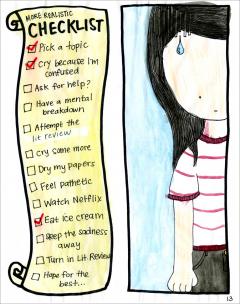
However, after Seanna's first list, Seanna's comic traces her progress on the literature review. Bad news: after some initial success, Seanna procrastinates and then struggles with various assignments, including APA citation and the arguments paper. She shows herself crying, confused, and realizing that she "would have to re-think [her] checklist." Retrospectively, Seanna understands that she has bought into a false ideology; she is not powerful, not superior.
The difference between the ego-run-wild of the first list and the more modest and humbled series of items on her second, "more realistic checklist," represents Seanna as having let go of her false bravado. Her ego is reined in.
Seanna's second checklist implicates the lit review as a trickster; Seanna loses control of her body; she cries, has a "mental breakdown," and "feel[s] pathetic," and trapped.
In contrast to the image of Seanna that accompanies the first list, the image of Seanna with the second list shows Seanna with a downturned face, a drip of sweat coming from her forehead. Additionally, we can see a series of dark bar-like rectangles superimposed in her head. The bars suggest a mental prison, which is doubled by the horizontal stripes on her shirt, suggesting the uniform of a convict.
If we consider the two lists together—the second list critiquing the faulty logic of the first list—we are left with a humbled image of the student, and the understanding that the student's previous logic represented a lack of humility and the sin of pride.
And note how the practice of procrastination is presented in the two lists. There is no sense of procrastination in the first list; Seanna presents herself as hard-charging, accomplishing everything. However, in the second list, Seanna indulges in pleasures such as eating ice cream and watching Netflix. Thus, the second list is a repair for Seanna's mental state; however, she still needs to complete the work, with which she continues to struggle.
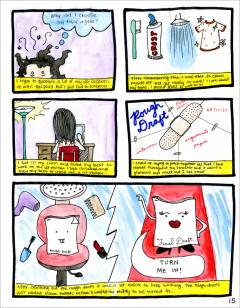
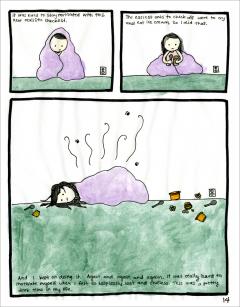
Following the second list, Seanna's comic recalls the "dark time" of being unable to make progress on doing the literature review. The comic details her procrastination through her aversion to the task, her fear of failure. She ends up in a heap, surrounded by garbage and flies:
The image of the student, Seanna, in a pitiable state, wrapped up in a blanket, eating ice cream, and eventually surrounded by filth and flies is all identified as a metaphorical "dark time" in the student's life (see Osborn, 1967). These images create a narrative vision of the student in a way that the second list alone does not capture.
This is the ultimate challenge for Seanna. She must find it within herself to overcome her shame and guilt, which were the products of her ego. Seanna's redemption is shown in images in which her physical transformation is mirrored by the physical transformation of the literature review. This is the moment of atonement.
Seanna's redemption is played out through images of her body. Seanna first appears dirty (matted hair, buzzing flies). However, she is transformed (brushed teach, a shower, and clean clothes) and thus transcends her despair, and gets to work on the lit review. Thus, the comic shows a symbolic cleansing, not only of Seanna's body but of her attitude toward her work. Similarly, Seanna's former monster is "patched together" with what Seanna has "learned." In parallel fashion to the image of the cleaned-up Seanna, the literature review is also transformed from being pathetically dog-eared and buck-toothed to being beautiful (e.g., long eyelashes, red lips, high-heels, and standing on a red carpet).
The result is that Seanna's atonement with the literature review is based on her new humility, on her acquisition of knowledge ("all that I had learned throughout the semester") which ends with the acknowledgement that "I was proud!"
In Seanna's comic, the difference in the content of the two lists may be taken as a sense of atonement. The monstrous ego of the first list, with its god-like sin of pride and perfectionism is given up in the second list. Seanna's "abandonment of the attachment to ego" is replaced with "hope for the best," which is based on "patch[ing] all that I had learned throughout the semester."
When students attempt to acquire knowledge, pride becomes something "both precarious and precious" (Lyman, p. 159). Seanna's claim that "I went to class and turned in my paper while standing TALL," evokes the heroic characteristics of the Western hero, being brave, having courage (Mish, 2003, p. 1275).
Seanna's comic ends with her walking down the road toward the rising sun, flashing the peace sign. We might take this as the beginning of a new day, a new future, with the peace sign suggesting that that harmony is restored to her world.