The Lit(erature) Review As Shadow
Early on the road of trials, while students are working on preliminary assignments, the literature review may be imagined as something frightening. At this point, there is no escape for the hero, for the enemy exists in the mind of the hero. The enemy represents an internal and imagined state of chaos and disorder.
Creating the "literature review" is based on students' understanding that it must be brought to exist into the world. It must go from an abstract "assignment" to becoming an actual paper, something that must be turned in, and something that will be "graded." The student's inner chaos must be confronted and externalized. It must be brought into existence; it must be disciplined and ordered. This is the mythic battle: the hero's moving from disorder to order. In creating the literature review, the student creates a written harmonic cosmos out of the chaos.
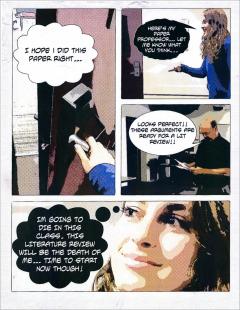
In Juliet Sivori's comic, the literature review may be represented as an idea that resembles an actual physical object. Juliet's imagined "death" in the class as a result of the literature review, is represented only as a black thought within a thought balloon. The image and words are doubled: the image colored black and the words "death" and "die." The image of the black cloud brings with it fear and vulnerability and "thoughts of the grave" (Osborn, 1967, p. 117). The images and ideology suggest a battle, in which Juliet loses, even though she acknowledges that it is "time to start now though!"
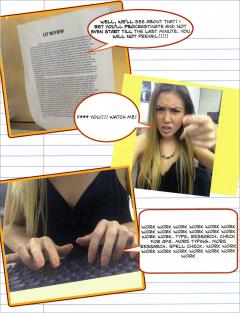
In Renee Samuelson's comic, the literature review is given life but is still shown as a written paper. Renee makes the literature review a worthy enemy, infusing it with a combative attitude who taunts Renee about her lack of knowledge ("you don't even know [APA]"). Although Renee mortifies herself by admitting her own limitations ("I may suck at APA") she shows her own combative nature and provides reasons why she will triumph over the literature review (i.e., she is "perfectly capable" and has been "putting in 110% effort"). When the literature review taunts Renee again with the charge that Renee will "procrastinate" and will "not prevail," Renee bests the literature review, using another body analogy ("F*** you!!!! Watch me!") to victimize the literature review and redeem herself. The scene ends with Renee typing furiously. The conflict between Renee and the literature suggests Renee's inner conflict and her discomfort with producing the literature review. However, within the context of the comic Renee's inner trickster successfully combats the literature review. The action within the comic is contextualized by objects that position Renee as an industrious student: images of lined paper and a pencil.
Renee acknowledges her limitations. And her redemption is signaled through her own mortification ("I may suck at APA…"), which is transcended through her ability to use technology; her "tools" include an online website. In contrast, the lit review is shamed by Renee's accusing finger and her labeling the lit review in regard to sexual activity ("F*** you!"). The sexual references are her trickster.
In other comics, the literature review takes on a physical presence and is often depicted as having an "extraordinary appearance" (Burke, 1966, p. 383). Several comics represent the literature review as a "monster."
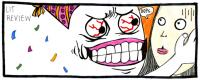
In Seanna's comic, she is actually grabbed by the "lit review," who takes on a monstrous appearance, including bloodshot eyes, big teeth. And Seanna's response ("Oops") indicates that she has somehow miscalculated.
Depicting one's self as a monster is somewhat common in autobiographical memoirs, in which the narrator's body may be seen as "monstrous" (see El Refaie, pp. 68-70). As a metaphor, monsters may be linked to the idea of the "uncanny," which Freud (1919) characterized as something that "arouses dread" (cited in Schneider, 1999). Given the discussion of the "dreaded lit review," the presence of monsters is not too surprising. In contrast to Seanna's comic, other students confront the monster within dreams.
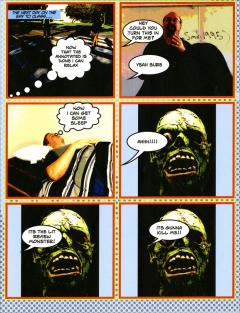
In Sean's comic, like Seanna's, the "lit review monster" is an enemy of "extraordinary appearance" (Burke, p. 383), although it retains some aspects of human appearance, with eyes, nose, and mouth. However, the monster is terrifying to the student, suggesting a zombie that will cause the student's death ("its gunna kill me").
The metaphor of the literature review as a monster may be interpreted as a manifestation of the student's fears. But even here, a monster is a "divine portent of misfortune" (Guralnik, p. 922; emphasis added), a warning the student conjures for themselves. In students' comics, the monster sometimes emerges while the student is asleep. In the mythic road of trials, "the hero moves in a dream landscape of curiously fluid, ambiguous forms, where he [or she] must survive a succession of trials" (Campbell, p. 97). In a sense, the presence of the monster within Sean's dream suggests his own "spiritual labyrinth" (p. 101).
What to make of this, students' representations of the literature review as a monster that can terrify students in their dreams? The student—now existing in the belly of the whale—confronts demons reflecting his or her own inner turmoil; the student faces dangers and problems that must somehow be resolved.
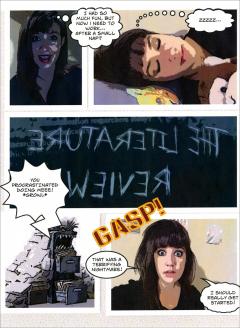
In Jordan Phillips's comic, the monster—again with ragged teeth and red eyes—appears within her "terrifying nightmare." In this comic, the appearance of the monster is associated with the student's avoidance or "procrastination." The representation of "THE LITERATURE REVIEW" in reversed writing suggests something demonic—the literature review—that takes possession of the student's body. This is perhaps a reference to the backward writing that appears on the skin of the character "Regan" in the movie The Exorcist, in which the devil takes possession of a child. However, in Jordan's comic, the image of the monster is combined with a filing cabinet, an object found in a professor's office. Thus, there is an association between the monster and the contents of the professor's filing cabinet (e.g., journal articles), and by association, the professor (i.e., me). Unlike Sean Baker's monster, however, Jordan's monster speaks or "growls" at her ("You procrastinated doing meee!").
Jordan's images show the student as someone who should be pitied, which suggests the need of mortification, in order to achieve the "purification of the self" (Campbell, p. 101; Burke, 1966), which can be accomplished by doing what is needed ("I should really get started!"), rather than doing what Jordan wants.
Even in the guise of a "monster," we may glimpse the literature review's shadow and trickster characteristics. In Sean's comic, the "literature review monster" suggests the student's lack of control; it invades Sean's sleep, suggesting the student's powerlessness. However, Sean's choice to represent the literature review as a monster suggests its shape-shifting abilities and its power, breaking through the structural boundaries of consciousness, entering the students' comics as subconscious nightmares, suggesting the students' desires to show themselves—with regard to having to write the "dreaded lit review"—as being out of control (Bassil-Morozow, pp. 56-57).
In both Sean's and Jordan's comics, the presence of monsters within dreams draws on our understanding that events-of-the-day may invade our dreams. The idea that dreams may reflect "unconscious" processes or things that we might want to repress (e.g., a horribly difficult assignment) is part of understanding our relation to myth (see Burke, 1966, pp. 63-80; Campbell, pp. 63-64; 101-104). We might see the dream as a projection of the shadow, and the acknowledgment of the monster within the comic as a projection of the trickster, in which the student creates a monster they have brought forth, a monster that serves the creation of a myth.
As a metaphorical monster, the "lit review," exists within a variety of contexts. Students have been exposed to monsters in numerous forms of popular culture, including comics, movies, and television. In such forms, the monsters are often "life-threatening." And the fact that the monsters appear in dreams linking them with the lit review is interesting. For when the student wakes up, the monster is gone; as is common with monsters, "the monster always escapes" (Cohen, 1996, p. 4; see also, Clark, 1996). But we might want to extend the metaphor of the monster and consider "the monstrous nature of language itself" (Cohen, p. x), and by extension, the act of academic writing, which is part of students' fear and shame, seems particularly open to its depiction as a monster.
In sum, the comics present an image of the literature review as something dangerous, the student's nemesis, able to dominate the student's life. In other words, the literature review is given life by the hero-student and is shown to be a worthy adversary. And with its boundary-breaking and shape-shifting characteristics, the literature review also represents the image of the student's tricksterish impulses. In this sense, "the monster stands at the threshold . . . of becoming" (Cohen, p. 20). While there are "trickster" elements in students' comics' portrait of the literature review, there is a stronger sense of the "shadow" elements, which support the idea that students' conception of the literature review is typically guided by the student's shame and fear, which is retrospectively transformed in the comic.