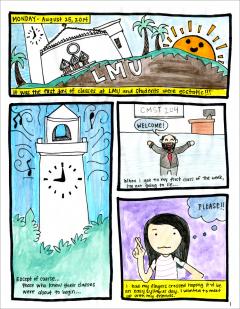
“The Call To Adventure” On The First Day Of Class
It is taken-for-granted that a course "syllabus" will be given to students on the first day of class. The syllabus outlines the content of a course as well as represents the logic of a course with lists: lists of objectives and assignments, lists of "do's" and "don'ts," lists of grades and points, a tentative schedule of the semester.
The syllabus represents a professor's power to control and structure what and how students do during the semester. It is a legal document that represents the ideology of the professor, the department, and the university. The syllabus states what students will be expected to know, do, and value. The syllabus is meant to be informative and helpful for the student. It is that. And more. It is power.
And from the university's perspective, I am also creating order. I sequence the assignments that students have to do, and as the "giver of grades," I create an administrative order, giving grades: A, B, C, D, and F. Later, students' grades will be combined into a number which is called the "grade point average" or "GPA." The GPA is the university's math to determine who receives "awards" and who is kicked out of the university, who gets financial aid and who doesn't, and which student gets put on "probation" before being temporarily sent down to the purgatory of junior college until she gets her numerical act together, as indicated by an "acceptable" GPA.
Here we go! I breeze into class. Students are chatting about whatever they are chatting about: weekend glories, or what they've heard about the class and the prof. There is an expectation that the first day be light on work, with little more than being greeted by the friendly professor, who distributes the course syllabus—this is "an easy 'syllabus day'"—in which nothing much happens, and the class session ends quickly so that the students can leave in order to "meet up with friends."
I go over the syllabus and watch as students' brows furrow and faces frown. Students will leave class this first day knowing that I intend to work them and work them hard. They will be assigned a series of papers that become increasingly difficult. The students will have to turn in hard-copies of pages of published research articles, marked up with their scribbled margin notes where they have identified arguments made by the author or authors. They will need to turn in a rough draft of the "dreaded literature review." I will expect students to learn how to write using APA style guidelines. And that the end-of-the-semester "literature review" can kick their ass so hard that they don't pass the class, which means they have to retake it the following semester. This is the "literature review" as shadow, students' projections of their own tensions, guilt, fear, and shame, between students and the assignment. And we're only ten minutes into the first day of class. Fear is in the air. I tell them to think about topics for papers; a topic that is interesting; a topic that will make doing the paper tolerable. So that it sucks less.
I talk to the students briefly about my own research: fake IDs, surfing, sorority rush, graffiti, women's roller derby, and repairing guitars in the rock 'n' roll world. I know how to do research. They don't.