The Divinity of Academic Writing
A literature review gives reasons why a particular research project is being proposed. The reasons are often a justification or a persuasive argument that synthesizes previous research. This type of writing—"academic writing"—is the real business of universities. And my literature review assignment is exactly that. I want students' literature reviews to mirror, to approximate, the writing in academic journals; I want them to be able to write the "god-voice." This presents a huge problem to the student: academic writing is jargon-filled, impossible to understand, clunky, devoid of beauty, and has no room for the student to tell their own story (Bartholomae, 1995; Elbow, 1991).
Most important: the "divine" writing is the "enemy." And the divinity makes the enemy—the literature review—a worthy adversary for the student. This is what instills in the student the desire to show in their comic creation the conquest of the literature review worth framing in mythic terms (see Burke, 1966, pp. 380-409).
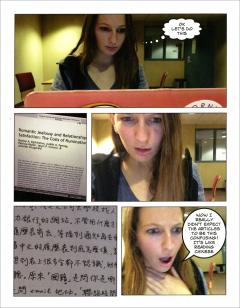
Christina Gallo's comic expresses a common attitude of students toward much academic writing. Despite the student's good intentions ("Okay, let's do this"), upon looking at the academic writing, Christina's expression registers shock and awe. She "didn't expect" to be confronted with writing so difficult to understand. The student's encounter with academic discourse is thus compared to being confronted with a foreign language that she does not understand ("It's like reading Chinese"). Christina's confusion may be taken as embarrassment or guilt. In some ways, comparing academic writing to a foreign language reduces her shame at her inability to read the article. No one would expect her to be able to read a foreign language that she does not know. Thus, her shame at being unable to interpret shadow-writing, in which the student is forced to confront a threshold marking her own limitations, is made humorous by a tricksterish joke, as she not only names the writing as "Chinese," but also shows the characters of the foreign language on what the reader would interpret to be her computer screen.
I ask students to dissect and take apart the journal articles—densely written slabs of confusion—looking for logical arguments, justifications and reasons, that students can use when making their own arguments, which end up justifying the asking of a research question. These tasks are not things students have been asked to do. In asking them to do these things, I am "imposing the ideology of a privileged [professor] class upon under[graduate] classes" (Rushing, 1990, p. 143). This is the real work of the academy. Student, write like us.
The student must learn to read and interpret the academic writing. Then the writing must be transformed into the student’s own "voice," one that is also "academic" in style. Easier said than done. Academic writing style is specific to academic disciplines. So what counts for scholarly writing in my discipline—Communication Studies—may be different than the academic discourse in the disciplines of English or History (Elbow, 1991).
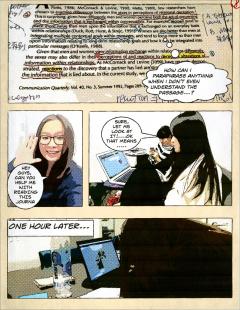
In the top panel, the academic discourse is shown marked up with comments in the article's margins; it is underlined and highlighted in red, yellow, and blue by the student. And yet, despite the student's effort to isolate what she hopes is the journal article's important content, the student is still unable to do what she needs to do. As the reader, you can hear Qinglan's exasperation at not being able to "even understand the passage," making it impossible to "paraphrase anything." Pure shadow; more shame.
Notice that the marked-up text has been placed in the comic panel's foreground, serving to impress the reader with Qinglan's efforts. Her thought is given to the reader, although she is not present in the panel. However, her sense of frustration, even terror, is highlighted. It is thus sadly ironic that the conventions of academic discourse include "impersonality and detachment" when the student is personally and painfully shamed (Elbow, p. 141).
The impersonal and detached conventions of academic writing are confronted by the comic's presentation of the student's voice. In this panel, it is the discourse of the comic's author that uses the first-person pronoun "I," which is often considered a violation of academic discourse. And in so doing, the author is mortified, embarrassed that she cannot do the assignment. The scene ends with the student seeking help from the Academic Resource Center, a campus office specifically designed to help students with their writing.
As we have seen in other panels, Qinglan Li's raised and open hand is raised to a higher power, seeking help. The Academic Resource Center, like the professor and the library, serves as a mentoring aid, a guiding light in the darkness of academic writing. Often times, students who realize they are struggling or are lacking in some particular area, make a point of signing up for regular appointments. It is worth noting that the A.R.C. is typically referred to as "the arc." There is divinity in this; "arc" originally referred to "the part of the circle that is the apparent path of a heavenly body above and below the horizon" (Mish, 1980, p. 70).