The Myth And The Title Page
Let's look at the "title page" of some students' comics about their experiences writing the literature review. The idea is that the title of a work serves as a "summary" of the comic's story, but the title also expresses the students' attitude toward the literature review. The attitude is often continued within students' comics, as the students tell their stories about writing the literature review.
Examples of titles from student comics:
Examples of titles from student comics:
"Trials and Tribulations of Writing a Lit Review: My Own Personal Hell"
"The Odyssey of Impossibility"
"Playmaker's Lit Review Conquest"
"Four Months in 204: A Research Communications Class of Epic Proportions"
"Weeks of Hard Work: The Process of Making a Lit Review"
"What the Lit?!?!?!?: Post Lit Review"
"League of Scheibels"
"The Dreadful Literature Review"
"How to Make Your Review Lit"
"The Story of the Dreaded Lit Review"
"How to Survive a Lit Review: A Rule Book to Success"
"My Worst Nightmare"
"A Journey Through the Semester: How I Created My Lit Review"
"The Seven Stages of Grief in Writing a Literature Review"
"The Journey of Writing a Lit Review"
"CMST 204: The Deadly Literature Review"
"Carina the Comic vs. The Lit Review"
"The Literature Review of Death"
"The Odyssey of Impossibility"
"Playmaker's Lit Review Conquest"
"Four Months in 204: A Research Communications Class of Epic Proportions"
"Weeks of Hard Work: The Process of Making a Lit Review"
"What the Lit?!?!?!?: Post Lit Review"
"League of Scheibels"
"The Dreadful Literature Review"
"How to Make Your Review Lit"
"The Story of the Dreaded Lit Review"
"How to Survive a Lit Review: A Rule Book to Success"
"My Worst Nightmare"
"A Journey Through the Semester: How I Created My Lit Review"
"The Seven Stages of Grief in Writing a Literature Review"
"The Journey of Writing a Lit Review"
"CMST 204: The Deadly Literature Review"
"Carina the Comic vs. The Lit Review"
"The Literature Review of Death"
Students' comics were created after the students finished writing the literature review. However, what is clear is that these titles suggest that students' attitude toward the "literature review" is that of a fearsome challenge. The "literature review" is an object often viewed as a dangerous opponent. The "literature review" is their nemesis, their enemy. And the process is…a quest.
The title pages often suggest a combat myth (Burke, 1966). In doing so, the titles raise the image of the student to that of a hero. This is done, in part, by the students' creating an image of the literature review to that of a fearsome challenge. The writing of the literature review is put forward as the battling of opposing gods, the student, and the literature review. If the literature review is the students' nemesis, understand that the word "nemesis" is rooted in the name of a Greek goddess, one who inflicts vengeance and justice (Guralnik, p. 830). In the course of the battle, the student-hero discovers her divinity. Thus, the titles forecast an "epic" battle, a mythic journey. The student is valorized, becomes a hero, even god-like.
The words in the titles suggest the idea of myth (cf. Burke, 1966; Campbell, 1973). And the titles of the comics—all written after completing the literature review—suggest the difficulty linked to the assignment, but more than that, reveal students' attitude toward their work, and their desire to retell their individual stories of writing the literature review terms that seem—to me—mythic.
The titles of students' comics are represented in mythic and ideological terms. For now, let's consider "ideology" to represent ideas concerning issues of social power. Consider the words: Death, Odyssey, Hell, Epic, Dread, Journey, Trials, Conquest, and "vs." (short for "versus," which suggests a contest between opposing parties or ideas). These titles try to sum up students' experiences with writing the “literature review.” In creating the title of the comic, the student performs a symbolic act that "dances an attitude" about the student's relationship with the literature review that the title expresses (Burke, 1973, p. 9; see also Heath, 1986, chap. 4).
These titles suggest power relationships that are barely hidden by the titles. The literature review is an example of "academic writing" that academic disciplines such as Communication Studies, and universities and professors want students to learn. In my class, the "literature review" is a synthesis of published research studies that serve as an argument that justifies the asking of a research question (e.g., How do same-sex siblings express their jealousy?). Students don't want to write literature reviews. But I want them to. And so does my academic department. And my university. Thus, the "literature review" is a form of the "dominant values" that the comics may either support or question and critique (McAllister, Sewell, & Gordon, 2001, p. 2; see also, Duncan, Smith & Levitz, 2015, pp. 339-346).
Let's take a closer look at the words and images of two title pages; the images below reveal much about the mythic nature of the literature review assignment. We'll be looking at the content in terms of myth and considering the word "dread," since both Nicole Franko's and Alexandra Fiore's title pages feature variations of the word ("dreadful" and "dreaded").
According to the Webster's New World Dictionary, the word "dread" suggests intense fear as well as "reverence" and "awe." While "reverence" is often used in reference to things that are sacred or holy, the word "awe" swings both ways. And the word "awe" is associated with things that are "awful" (e.g., hate, death) as well as things that are "awesome" (e.g., love, god). So, we can be awed by both these things: love (also called eros) and death (also called thanatos). We can understand how the ideas of love and death fit together in terms of students' desire, which is a kind of love, to complete a hard task—like writing of the "literature review"—and the completion or gratification of that desire, which we can understand as the death of that desire. In this sense, "love" and "death" reflect the purpose of the myth (Burke, 1966).
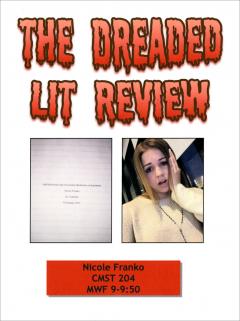
Nicole Franco's title page shows her facial expression, suggesting a sense of awe or apprehension, directed outward toward the reader. The words "The Dreaded Lit Review" is colored red, with the image of blood dripping from the letters. Although blood sometimes suggests death, it also suggests life. The "Dreaded Lit Review" bleeds, just like Nicole. Thus, she and "The Dreaded Lit Review" have something in common; they share the substance of blood. And the sharing of substance provides for a means for Nicole to identify with the literature review. They both live. This is significant, because the "'awesome properties' of blood" create the possibility of various types of interactions between the student and the literature review (Makarius, 1993, p. 71; emphasis added; see also Durkheim, 1897, cited in Makarius).
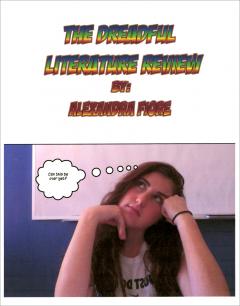
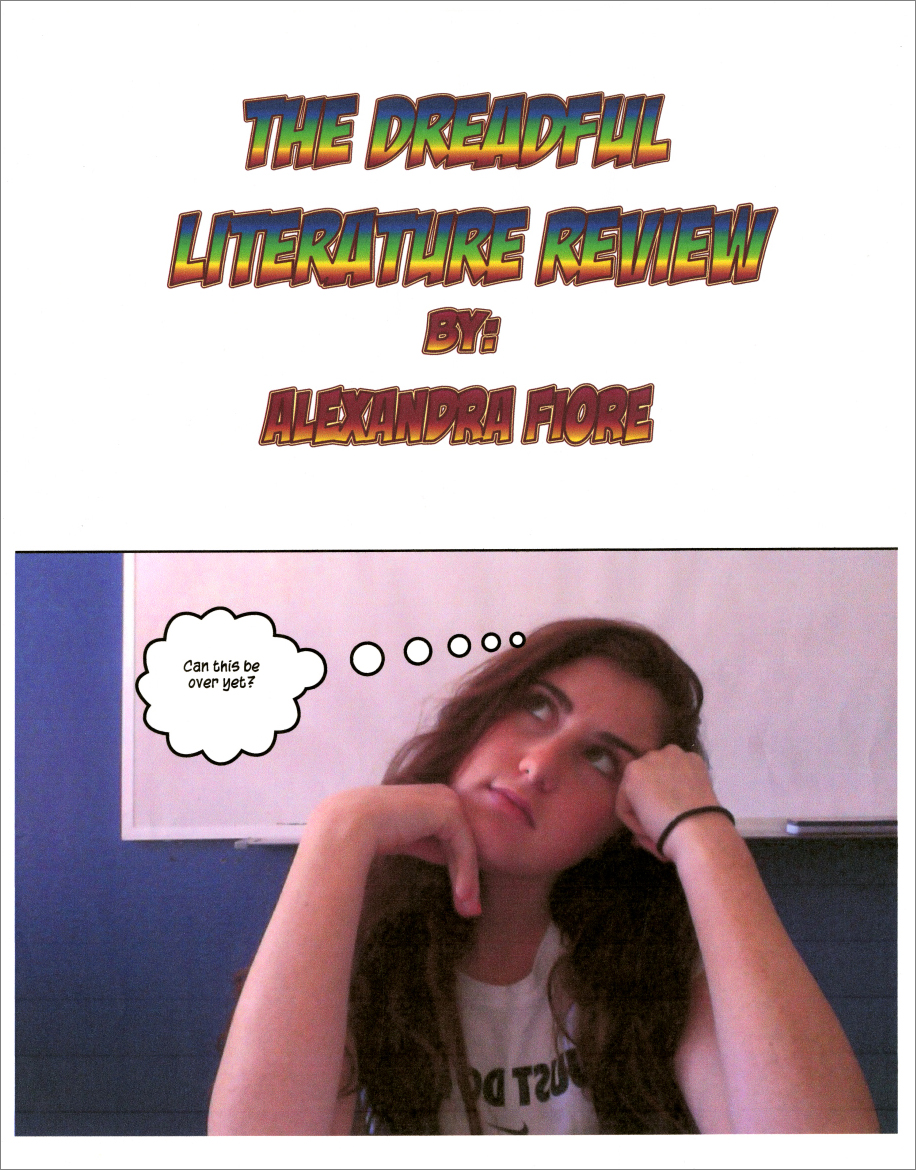
Alexandra Fiore's title page's photo shows Alexandra looking up at the title ("The Dreadful Literature Review"), as if she is pleading or seeking intervention from a divine power ("Can this be over yet?") to deliver her from an evil task, which inspires her sense of awe. In both titles, the images of student’s hands and facial expressions support the idea that the literature review is something that is both feared and awed. However, Alexandra’s title, with its rainbow coloring, suggests something hopeful, something mythically unifying and divine.
The myth summarized in these images is that of the student in the middle of a battle. In the battle, the student's nemesis is the literature review. Importantly, the titles suggest that the literature review is a worthy adversary, a match for the student. The outcome of the battle—victory for one, and the defeat of the other—is still to be determined, although in reality, by the time the students have created the comic, they have completed "the dreaded literature review." Thus, the comics' titles suggest a dangerous enemy, making the student's conquest of that enemy heroic.
In having students create comics about doing the literature review, I am opening a door that allows students to create a narrative or a story that can reflect on the process of doing traditional academic writing (i.e., logic, argumentative reasoning in support of a thesis, and citing academic sources as evidence to support their argument). I am also asking the students to place themselves at the center of the story. In contrast, traditional academic writing asks the author to disappear behind the argument being made. So, my assignment—the comic—asks the students to place their own experiences of writing front and center to tell the story in the first-person (i.e., "I," "me," "my"), and to use images as well as words.
Nicole's title drips blood, suggesting the transformation of the literature review from a bloodless, non-living "assignment" into a living, bleeding thing, marking the literature review's metamorphosis into a "trickster." The trickster is a mythic figure, and Nicole's title reflects shape-shifting abilities. Other characteristics of tricksters are as creators of chaos; tricksters may uphold or disrupt existing social orders or hierarchies while making fun of them, breaking boundaries; tricksters may lose control or gets others to lose control; they may be obsessed with sex and swear a lot; and they tend to disappear or dissolve when the story is over (Basil-Morozow, 2015; Hynes & Doty, 1993).
If the student is the hero, the literature review represents both the shadow and trickster sides of the hero. As a "shadow" image, the literature review is shown as an extension of a student's shame, fear, and lack of control. But in the image of the "trickster" such fear and shame are acknowledged and may show the student's reactions to the literature review assignment. Thus, within the comic the trickster may serve to highlight the existing social orders. Nicole's bleeding title brings the literature to life, but the shedding of blood also suggests the literature review's vulnerability; it can be conquered by the student.
In looking at the titles of the comics, the "literature review" (and its abbreviation, "lit review") is often mentioned, although the term "trickster" is not. However, the idea that the literature review has been transformed into a tricky adversary, the student's nemesis, is a start to understanding the literature review as a "trickster."
Many of the students' comics' titles reflect students' choices to name or rename the "literature review" as the "lit review." What to make of this? This is not merely a shortening, an abbreviation of a word. No. "Lit" is a change in the substance and meaning of a word. Students are symbol-users, word-creators and the creation of the "lit review" reflects and selects meanings somehow related to students’ experiences of writing the "literature review."
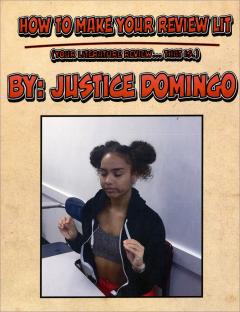
Consider the title page of Justice Domingo. "Lit" pushes "literature" aside as "lit" takes the spotlight. The word "literature" refers to written research reports; the word is class-based and high-brow; it is a word used by academics, by professors. In contrast, "lit" is more than mere abbreviation; rather, "lit" is current student slang, suggesting brightness, excitement, action, even sexuality, and alcohol and drugs (e.g., "lit up") (see Mish, p. 726). The trickster connotations of "lit" are understood as cool and crazy, manic, and even out-of-control. “Lit” brings it closer to the student.
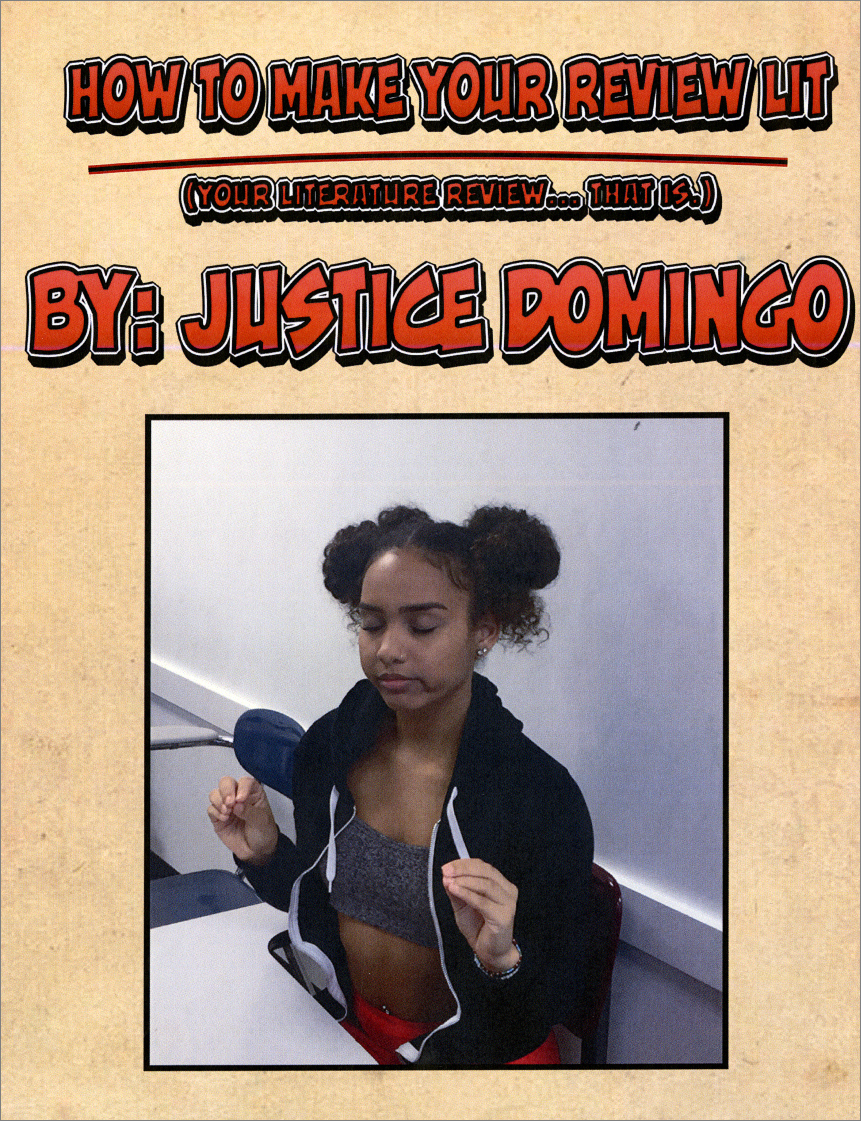
In this sense, the "lit review" is breaking the boundaries of what a "literature review" is supposed to be; it is not the proper name for a term paper; rather, it seeks a different shape, a different name, one that suggests that it may be out-of-control, given its "lit" potential in terms of sex and alcohol. All these ideas or themes or motifs are the sign of the trickster (see Bassil-Morozow, pp. 12-31). And the renaming the "lit" review also suggests an empowerment of the students by mocking the high-brow origins ("literature"), taking it down a peg, making an ideological challenge to the dominant values of academia.
The change from "literature" to "lit" reflects the students' myth-making abilities, and attests to students' ability to establish their own ideological foundations, their own shaping of schoolyard power relations. So, let's accept the possibility that the term "literature review" and its "lit" alter-ego might possess complexity and mystery that might be revealed in the telling of the myth.
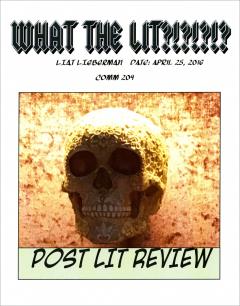
Consider Liat Lieberman's title page, which reflects ideas associated with both shadow and trickster. "What the Lit?!?!?!?" substitutes "lit" for "fuck" (as in "What the fuck?!?!?!?"), which suggests the student's shock and outrage at having to do the "literature review." It suggests a rebelling against the structured world assigned to the student; and this rebellion is the student's strategic projection of the student's loss of control, an idea common to the trickster. Finally, the student's use of the term "lit" as a substitute for "fuck" might be linked to the trickster's potential for boundary-breaking and sexual obsession (see Bassil-Morozow, Chap. 1). The image of the "grinning skull" suggests that the student has survived a near-death experience, while successfully defeating the literature review. This works well with the comic's subtitle, "Post Lit Review," which suggests the word "posthumous," meaning "after death" (Guralnik, p. 1113). The associations between sex and death are many, mythic, and need not be recounted here.
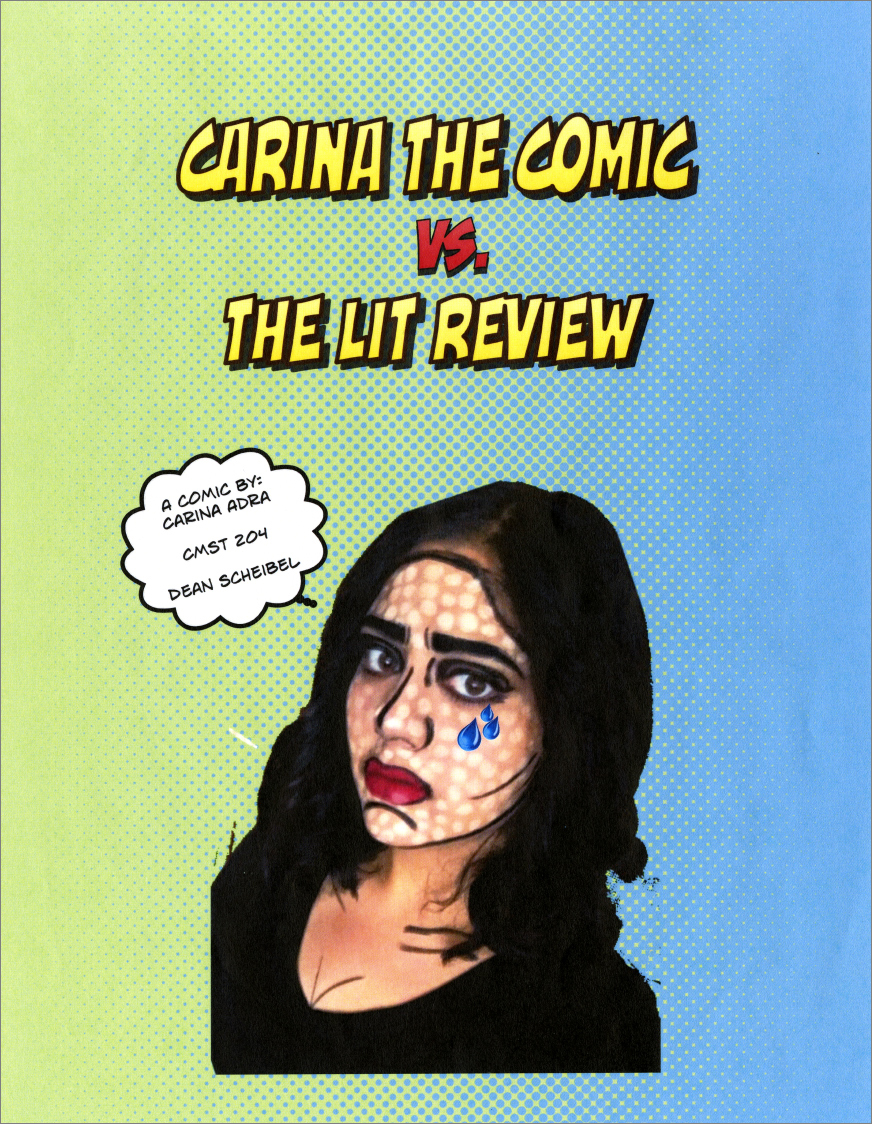
Finally, consider Carina Adra's title page. The term "versus" commonly is used to suggest a contest, in which the outcome is uncertain. However, the title suggests a bit more. On one hand, "Carina the Comic" suggests a merging of the person, Carina, with the comic that Carina has created. Her manipulation of the photograph of herself, to which lines, spots, and tears are added, creates a character that seems not completely human; in short, Carina resembles a character one might see in a comic book. And if we consider Carina to be the comic, then the title suggests a contest between two different ways of writing, the comic versus the literature review. Carina is moving beyond saying that students should experience both types of writing; rather, she is suggesting that these different types of writing are locked in combat. And as the battle begins, it is the narrative within the comic that controls the story, the myth. Traditional logic and reason is the enemy. And as a form of writing, the comic has mythic potential, which is a staple in the universe of comic superheroes (see Duncan, et al.).
Carina's title suggests that the idea of a trickster is NOT limited to being a character in a story, but that the telling of the story in the form of a comic might be considered a form of trickster discourse in its own right. That is, the "sinful" nature of comic discourse—the combined use of both words and images—represents an ideology in opposition to the accepted and dominant patterns of academic discourse (see Bartholomae, 1995; Doueihi, 1993; Elbow, 1991). The comic—as an enactment of the trickster—breaks the structural boundaries of existence, pushing itself to combine with the student hero.
In sum, the student-hero myth and the ideological power relations are reflected in both the words of the titles and the images shown in students' comics' title pages. The analysis of the comic titles previews the student journey, a mythic confrontation between students and the "dreaded lit review." The literature review is represented as both the "shadow," a projection of the shame and fear of the students, and as the expression of the student as "trickster," in the transformed "lit" review.
Although "lit" is an abbreviation for "literature," it also refers to being drunk. But it also refers to light. Thus, the comic shines light on the literature review, shines light on the shadow, and acknowledges the shame of the shadow. Thus, the "lit" review, portrayed in the comic, reveals the student's trickster sensibilities.
The change from "literature" to "lit" reflects the students' myth-making abilities, and attests to students' ability to establish their own ideological foundations, their own shaping of schoolyard power relations. So, let's accept the possibility that the term "literature review" and its "lit" alter-ego might possess complexity and mystery that might be revealed in the telling of the myth.
Consider Liat Lieberman's title page, which reflects ideas associated with both shadow and trickster. "What the Lit?!?!?!?" substitutes "lit" for "fuck" (as in "What the fuck?!?!?!?"), which suggests the student's shock and outrage at having to do the "literature review." It suggests a rebelling against the structured world assigned to the student; and this rebellion is the student's strategic projection of the student's loss of control, an idea common to the trickster. Finally, the student's use of the term "lit" as a substitute for "fuck" might be linked to the trickster's potential for boundary-breaking and sexual obsession (see Bassil-Morozow, Chap. 1). The image of the "grinning skull" suggests that the student has survived a near-death experience, while successfully defeating the literature review. This works well with the comic's subtitle, "Post Lit Review," which suggests the word "posthumous," meaning "after death" (Guralnik, p. 1113). The associations between sex and death are many, mythic, and need not be recounted here.

Finally, consider Carina Adra's title page. The term "versus" commonly is used to suggest a contest, in which the outcome is uncertain. However, the title suggests a bit more. On one hand, "Carina the Comic" suggests a merging of the person, Carina, with the comic that Carina has created. Her manipulation of the photograph of herself, to which lines, spots, and tears are added, creates a character that seems not completely human; in short, Carina resembles a character one might see in a comic book. And if we consider Carina to be the comic, then the title suggests a contest between two different ways of writing, the comic versus the literature review. Carina is moving beyond saying that students should experience both types of writing; rather, she is suggesting that these different types of writing are locked in combat. And as the battle begins, it is the narrative within the comic that controls the story, the myth. Traditional logic and reason is the enemy. And as a form of writing, the comic has mythic potential, which is a staple in the universe of comic superheroes (see Duncan, et al.).
Carina's title suggests that the idea of a trickster is NOT limited to being a character in a story, but that the telling of the story in the form of a comic might be considered a form of trickster discourse in its own right. That is, the "sinful" nature of comic discourse—the combined use of both words and images—represents an ideology in opposition to the accepted and dominant patterns of academic discourse (see Bartholomae, 1995; Doueihi, 1993; Elbow, 1991). The comic—as an enactment of the trickster—breaks the structural boundaries of existence, pushing itself to combine with the student hero.
In sum, the student-hero myth and the ideological power relations are reflected in both the words of the titles and the images shown in students' comics' title pages. The analysis of the comic titles previews the student journey, a mythic confrontation between students and the "dreaded lit review." The literature review is represented as both the "shadow," a projection of the shame and fear of the students, and as the expression of the student as "trickster," in the transformed "lit" review.
Although "lit" is an abbreviation for "literature," it also refers to being drunk. But it also refers to light. Thus, the comic shines light on the literature review, shines light on the shadow, and acknowledges the shame of the shadow. Thus, the "lit" review, portrayed in the comic, reveals the student's trickster sensibilities.