The Belly Of The Whale
Eventually, students settle on a topic, and this threshold marks the passage into the mythic "sphere of rebirth." In myths, this is "symbolized in the worldwide womb image of the belly of the whale" (Campbell, p. 90). On a physical level, the sphere of rebirth is the university's William H. Hannon Library. It is a large round building, several stories high, and perched on a bluff, overlooking the Pacific Ocean, as if it had risen from the sea.
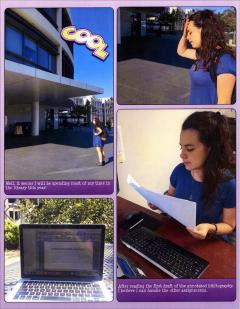
Although Scarlett labels the library a "COOL" place (suggesting a trendy-good-hip thing), she stands before the library looking up, and the panel’s text suggests that she has resigned herself to the fact that she "will be spending most of [her] time in the library." Moreover, the following panel shows Scarlett looking down, her head in her hand. Thus, there is also a "coolness," suggesting a lack of enthusiasm. Spending of time in the library is not something she wants to do.
Having been symbolically engulfed or "swallowed" by the library, the student must fight against their own feelings of inadequacy and shame. Libraries are "secretive, mysterious, and anxiety-producing places" (Grassian & Kaplowitz, p. 90; see also Fitzpatrick, 1992). Students feel overwhelmed, maybe even pathetic: they don't know how to access databases, how to cite journals, how to read research, and how to write about what they have read. It is within the belly of the library's universe of discourse that students must cease to exist and be symbolically "born again," with the acquiring of new knowledge (Grassian & Kaplowitz, pp. 91-92). Thus, initially, forms of technology that are new and unfamiliar to students are feared and are projections of the shadow (cf. Rushing & Frentz, 1989).
In the myth, "the belly of the whale" may be interpreted as an overarching scene, a place where students travel the "road of trials" (Campbell, p. 97). These "trials" may be viewed as class assignments, each building upon the last, which finally end with the students' attempting to write the "literature review."
In doing these assignments, students fight against their anxieties, even as they attempt to build the skills and competencies that will aid them as they battle toward the literature review. Librarians and libraries play an important part in the students' travel on the road of trials; they are the guides on the road of trials, providing instruction on "information literacy," which provides the "gateway to knowledge" (Grassian & Kaplowitz, p. 89). Librarians become mentors to students who provide guidance to them. Far from only being physically present at "reference desks" to help students, librarians also interact with students through computers. These sessions provide technological "amulets," charms of knowledge that may provide the power needed to protect the students from injury and evil.
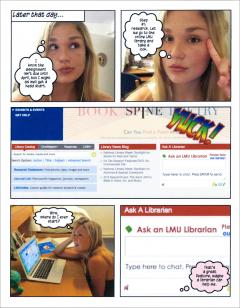
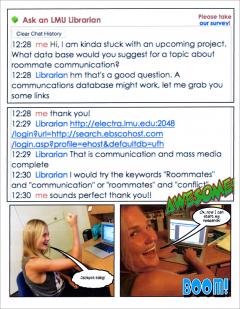
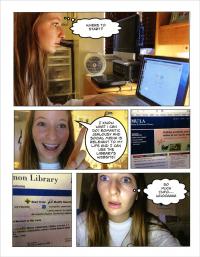
Emily's initial disgust ("Yuck!") and confusion ("Wow, where do I even start?") is reduced when she finds help by communicating with a librarian via computer ("Ask a librarian"). The information produces an abundance of useful information. The words "jackpot" and "boom!" both suggest sudden rapid growth, an "upsurge in activity" (Guralnik, p. 142). Both words also suggest the metaphor of gambling. And Emily wins. In this case, "awesome" refers to that which is venerated, held "in wonder that is inspired by authority or by the sacred or sublime" (p. 86). Emily’s comic reflects the "crooked lanes of [her] own spiritual labyrinth" as she finds some guidance from librarians, which is channeled through the technological trial encountered (Campbell, p. 101).
Like all libraries, the Hannon Library has many aisles of books. However, much of the work students do in creating the literature review does not involve books, but rather, academic journals, which are found in computer "databases" that are organized around "disciplines" (e.g., sociology, dance, psychology, art history). Students' confusion about locating databases and finding sources suggests the metaphor of an electronic maze or labyrinth, one far more difficult to navigate than finding books, and which creates shame and anxiety (see Grassian & Kaplowitz). And the electronic labyrinth has its birth in mythology, in which Ariadne gives Theseus a skein of linen thread so that he will be able to find his way out of the maze. Thus, librarians play the role of Ariadne, laying out the string, for the student's Theseus. In this mythic scene, the literature review becomes the Minotaur, a divine monster which lives in the maze, and which must be slain by Theseus.
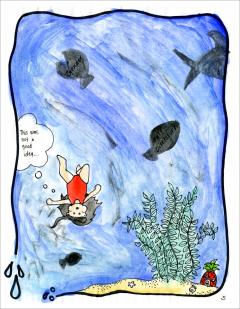
Even after a topic has been settled on, and appropriate databases located, students are faced with facts that produce fears. There are many journal articles on most topics. Students often find themselves confronted by the extreme volume of information with which she must grapple. It is an interesting coincidence that the academic articles are collected in "volumes"; the word volume refers to a series of issues within a periodical (e.g., an academic journal), as well as "considerable quantity" (Guralnik, p. 1402). In a sense, the plunge into a published volume is an echo of Seanna's plunge into an ocean; where a student first finds herself drowning in a sea of topics, now she is a more condensed version: a sea of research articles, a sea of words.
Students are thus plunged into a universe of discourse that leaves them awed, fearful. Christina's comic represents her experience by the expression of awe—in this case, dread—that is prompted by what confronts her on the computer screen. And beyond the sheer number of sources students face, students need to select which sources—the right sources—to use. Students need to narrow their topic. For example, the topic of "jealousy" might be narrowed to "sibling jealousy" (as opposed to "romantic jealousy"), which might be narrowed to "same-sex sibling jealousy." Adding to the difficulty of narrowing the topic is that students discover that reading academic writing is really difficult.