The Crossing Of The First Threshold: Finding A Topic
I encourage students to find something that interests them, something in which they are involved. The “interest” is typically a context, often an organization or activity in which the student is involved: a sorority, a sport team, a romantic relationship, or the student’s family. But with a condition: a student’s literature review needs to focus on a specific communication phenomenon. For example: social support in sororities; verbal aggressiveness in sports teams; deception or flirting or complaining in romantic relationships; sibling jealousy in families.
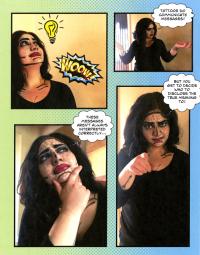
Often, students draw on their own experiences to locate a topic. And students’ comics often present a narrative about how they found the topic for their literature review. Some topics are the result of students’ past struggles. Students use technology, particularly cell phones, to set up their stories. Unlike other forms of technology (e.g., computers and databases), which may be problematic for students, the cell phone is not represented as a problem, although the messages may be disturbing.
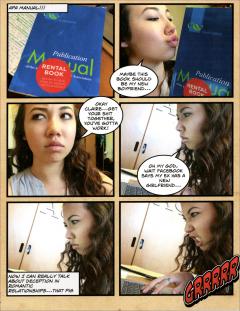
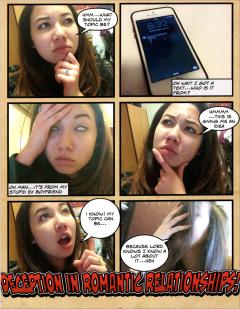
In Claire Dobyn’s comic, the phone message from her “ex-boyfriend” elicits the image of Claire’s eyes rolling backward into her head, symbolically suggesting unconsciousness, even death. This image is quickly followed by a moment of divine redemption, which is captured in images of Claire’s upward-seeing eyes, and the invocation of the divine (“Lord knows”). However, Claire’s covering her face with her hair, suggests her own shadow of shame; she is mortified, and acknowledges her embarrassment concerning her topic (“Deception in Romantic Relationships!”).
Claire’s inner trickster is also at work. She makes fun of herself, suggesting that her APA manual “should be [her] new boyfriend.” Moreover, when she looks at her Facebook and finds that “[her] ex has a new girlfriend” she admits her own anger, ironically states that “now I can really talk about deception in romantic relationships,” and she symbolically humiliates her former boyfriend, lowering him to being less than human (“that pig”).
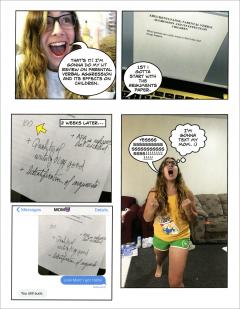
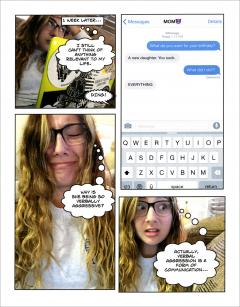
Similarly, Chandler Wright’s discovery of her topic is also realized through the cell phone and her relationship with her mother. In this case, she has programmed her phone to show an “emoji”—a visual image of a grinning devil—which is displayed when her mother calls. The grinning devil—a trickster image—may be taken to represent a problematic power relationship with her mother, who denigrates Chandler’s qualities of being a daughter [wording?] (“You suck.”). Beyond that, the image shows Chandler’s perception of her mother’s unfulfilled expectations, that she is not the “perfect” daughter. The idea that Chandler “sucks,” is mortifying to her; thus, we understand that her act of choosing to display the emoji is another challenge that she encounters, one in which she symbolically speaks truth to power.
The problem is solved when Chandler realizes her mother’s verbal aggressiveness can be turned into a research project. Chandler’s clenched fists, victory cry (“Yessssssssssssssss!!!!!”), and upturned face, signify her redemption, even as her comic recognizes the irony of the situation (“I’m gonna text my mom”).
Both Claire’s and Chandler’s comics show shadow images, suggesting some shame associated with the topics they have selected and the lack of love from significant others. In both cases, the topic for the literature review is connected to something that is a problem for the student. This is a common theme for shadow images. In both cases there is a sense of loss, in the sense that the “love” of previous relationships is a remembered “loss” to the student (Bassill-Morozow, pp. 56-57). And yet, there is some lightness and a trickster attitude that allows the student some control, humorously mocking herself, thereby dragging their shadow-shame into the light.
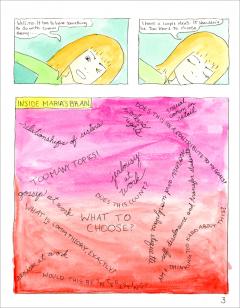
In Maria Nelson’s comic, she represents the selection of a topic as an inner confusion, with a variety of topics being considered that are related to academic or career goals, and other interests.
The depiction of the topics in a floating, jumbled, random fashion “inside [her] brain” suggests a lack of clarity as a result of too many options. The image of the topics suspended in a jello-like substance, neither completely liquid nor solid, also suggests a vague and undetermined state. The near-liquid state—the substance in which the topics are floating—suggests the image of an ocean or a sea.
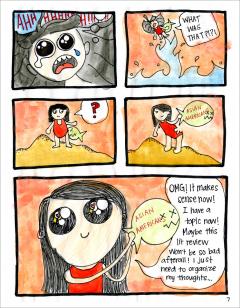
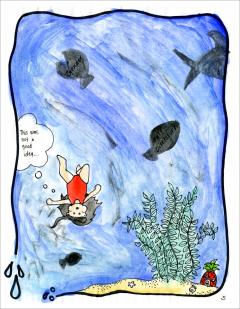
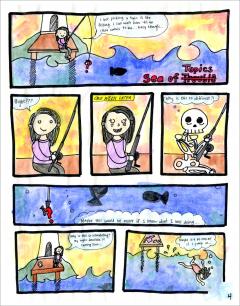
The imagery in Maria’s comic is similar to that in Seanna Duong’s comic, where the search for a potential topic is located in an ocean, where the metaphor of a “sea of trouble” has been renamed a “sea of topics.” Nonetheless, the association of “topics” with “trouble” seems significant.
The image of the sea has long been important to writers and poets as a mythic metaphor. The sea is a place of chaos, immersion, and purification, and is a place that contains “the moments of eternal choice, of temptation, fall, and redemption” (Auden, 1950, p. 14; see also Osborn, 1977; Scheibel, 1995). Thus, the sea provides a mythic context for Seanna’s journey.
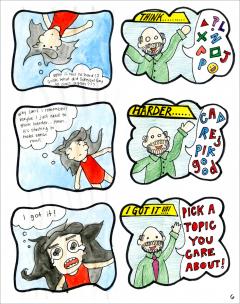
Seanna’s representation of finding a topic begins with a comparison: “picking a topic is like fishing,” suggesting a degree of luck, which doesn’t work well for Seanna. What begins as being “easy enough” becomes images of embarrassing death because she can’t find a topic. In a trio of images, Seanna ends as a skeleton—an image of death—and wondering “Why is this so difficult?”
Seanna then enters the sea, “jump[ing] in,” but quickly finding that she is in trouble (“this was not a good idea…”) as she is surrounded by dangerous-looking fish, labeled with topics (“Gender” and “self-disclosure”). The image of Seanna, engulfed in water, suggests a shadowy darkness, a projection of her fears.
The next page represents the process of Seanna trying to remember the advice given by the wise old professor (“Gosh, what did Scheibel say in class again?”). Seanna remembers as she is bitten by one of the fish, labeled “Asian Americans.” The fish dies—symbolized by the “x” on the fish’s eyes—while gratifying Seanna’s desire to secure a topic. The image recognizes some mortifying pain inflicted on Seanna—the fish takes a bite out of Seanna’s backside and is dead—suggests the idea that “every creature lives on the death of another” (Campbell, p. 238). The scene also links the mythic themes of death and love, the latter expressed in her gratitude toward the divine upon discovering a topic (“OMG!”).
In both Maria’s and Seanna’s comics there is a sense of the shadow. The students’ inability to choose among potential topics might be viewed as a source of interior shame, where topics are suspended in dark liquid and water, which are images of shame that have been associated with Sigmund Freud’s ideas on narcissism, or self-love (Bassill-Morozow, pp. 54-55). The liquid and dark reference to doomed self-love has roots in Greek myth of Narcissus and Echo.
Seanna Duong’s depiction of finding a topic also promotes the mythic image of the old professor—that’s me, folks—who may also be a source of wisdom. Thus, we turn to the theme of “mentors,” which are part of the hero’s mythic journey. Although sometimes depicted as a devilish figure, the student’s image of the professor also transforms over the course of the semester, projected as both shadow and trickster.
In Kateri’s Milanesa's comic, I am represented as a more traditional mentor, one who may be a resource for a student as she works on her literature review and comic. Some myths “develop the role in the great figure of the guide, the teacher” (Campbell, p. 72). And some students recreate this mentoring relationship for their comics.
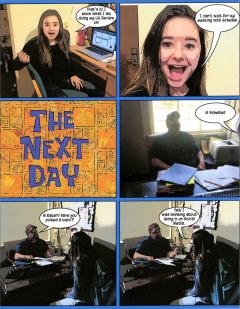
In Kateri’s comic, which she created after she finished the literature review, Kateri asked to shoot pictures of me in my office, a fairly common request made by students. In this instance, Kateri represents the situation as one in which she had already come up with an idea for her comic and just wanted confirmation that the topic was appropriate.
However, in other instances, students may seek out the mentor when they are struggling to find a topic, as was the case with Carina.
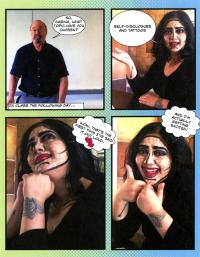
In Carina Adra’s comic, she comes to my office, embarrassed and ashamed and having feelings of guilt because she didn’t have a topic and is therefore not living up to the standards of being a competent student. Carina’s mortification is expressed in images and words: the “palms up” image and the admission “I’ve got nothing,” evoke the idea that the student should have a topic and should not show up for an appointment empty-handed. However, her shame is also expressed in her use of the word “Shit,” which is a colloquial expression used to express the lack of something (e.g., “I don’t have shit”). Thus, the load of the assignment cannot be unburdened from the student, a point of embarrassment or shame.
During a conversation after class, I had noticed that Carina had tattoos on her arms, and I suggested tattoos as a topic because “you should write about what interests you,” a common sense idea which runs counter to Carina’s assumption that “research [is] supposed to be boring.” And something that is boring brings on an association with death (e.g., “bored to death”).
The image of the professor as offering sage advice is advanced as Carina thinks about tattoo’s and links them to a viable communication topic (“self-disclosure and tattoos”). The image of Carina, hands-folded under her chin, upward-gaze, and loving (two hearts) realization that she’s “actually getting excited!” Thus, we see the expression of the mythic tension between death and
love.
In Seanna’s, Kateri’s, and Carina’s comics, the teacher supplies “the advice the hero will require” (Campbell, p. 72). The mentor or teacher may be viewed as helpful and may be something of a “protective figure,” although the figure may take a variety of forms. Campbell notes that this figure may take the form of “a little old crone or old man” (p. 69). That’s me, the old man.
This page has paths:
This page references:
- The Lit Review and Me
- The Lit Review and Me
- The Lit Review and Me
- The Claire Chronicles
- Carina the Clown vs. the Lit Review
- The Lit Review and Me
- The Literature Review
- The Literature Review
- Transfer Girl!
- Carina the Clown vs. the Lit Review
- Carina the Clown vs. the Lit Review
- Carina the Clown vs. the Lit Review
- The Claire Chronicles
- CMST 204